Showing posts with label trends. Show all posts

Dec 31, 2010

Learning from the Big Guys, End-Of-Year Edition

Some of my best landscape design inspirations come from simply walking around in the world. It's also a fantastic education, and you can't beat the price. Here are a few of the lessons I've learned this year — for worse and for better.


The good: at NapaStyle, Yountville
The bad: Carlsbad office park
The just plain stupid: San Mateo mall

Handle your water. Water in the landscape can be a wonderful element to either enliven or calm a space. Unfortunately, from poorly designed irrigation that applies more water to the pavement than the lawn, to poorly conceived drainage that creates safety hazards, there's no shortage of examples of ways we all can handle our water better. My "Worst of the Wettest" award goes to the fountain at an outdoor shopping center in San Mateo. The open, parklike setting is so sunny, so warm, so lush, so… so stupid to create a ramp right up to the water's sparkling edge, then post a "No Water Contact Allowed" sign.


I just hope the tequila was worth it

This used to be a Black Oak

Why bother?
Hedgehogs on parade


Make the right cut. When you put plants in a landscape you're entering into a bit of a contract. They'll provide shade and process carbon dioxide, and you'll give them food, water and a bit of tender loving care every now and then. Unfortunately, too many gardeners — homeowners and municipal landscapers alike — forget the "tender loving care" part, and we wind up with pruning abominations like these. My "Cruelest Cut" award goes to whomever decided California Gray Rush should be pruned into little hedgehogs every winter. (Hint: it's not actually a grass. Let it grow.) It's not fair to the plants, and it's not fair to those of us who have to look at them.


Sculpture at building entry in SF

At UCSF Mission Bay, paving acts as carpet

Look up! No, up!


Where's the magnifying glass?

Lead the way. An entire industry has evolved around "wayfinding" — the art of helping people navigate through complex environments, particularly in urban settings. Personally, I really enjoy when this can be achieved implicitly, with landmarks such as sculpture or variations in paving materials rather than explicit signs. Sometimes, though, signs simply are the best medium for communicating what lives where. But they're pretty useless if they're so tall, and the lettering so small, as to be unreadable. My "Losing Sight of the Destination" award goes to the City of Palo Alto, which installed such signs at major intersections along University and California avenues. Good thing no one goes there anymore.


Emerging from the earth…

… vs. dropped from the sky.

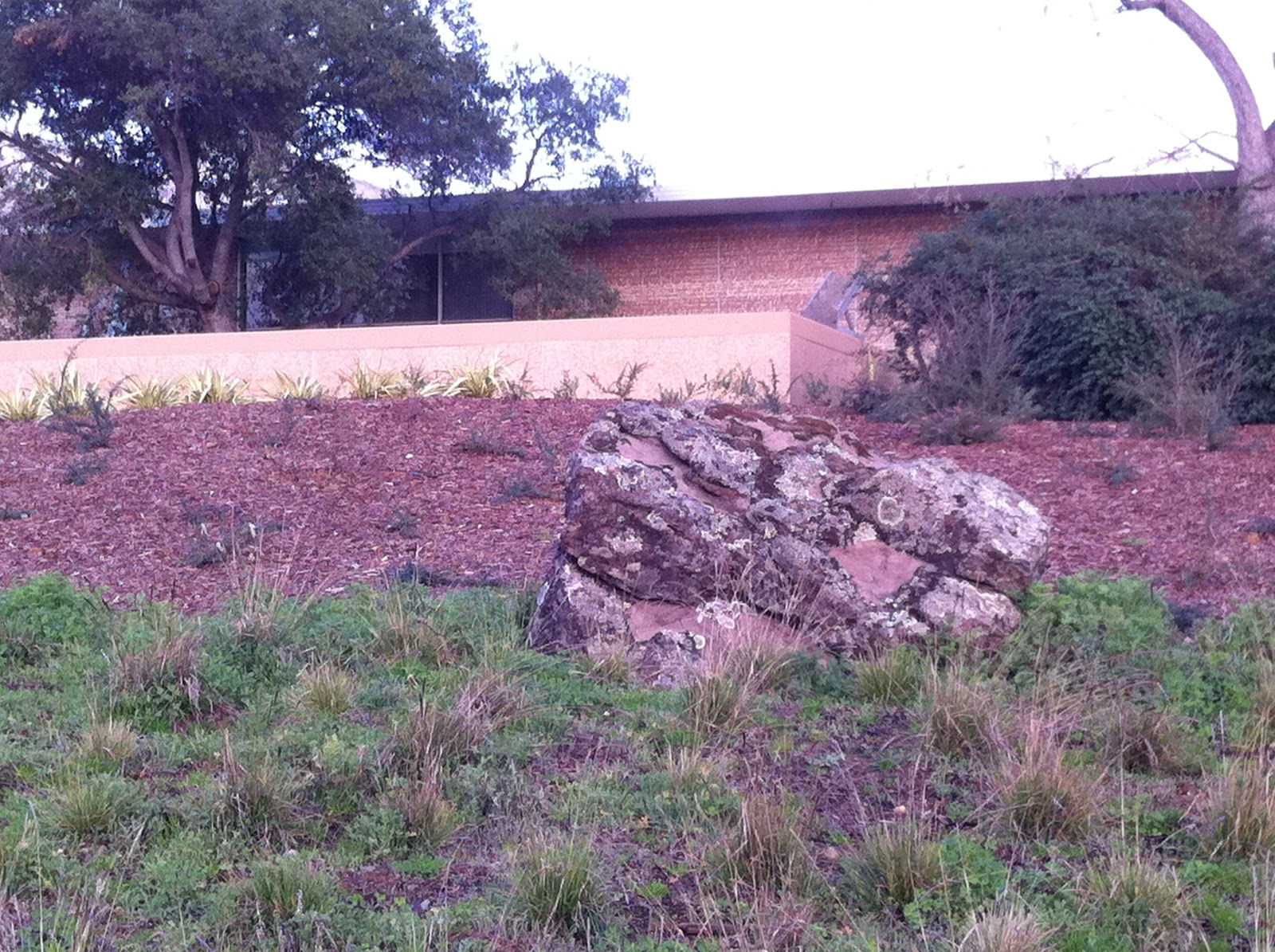
Rock out. Boulders in the landscape are timeless sentinels, a great way to define spaces and make any area feel more natural. They look their best when they seem to be emerging from the earth — I typically specify they be buried to about 1/3 of their height. And bigger is better, perhaps because it seems impossible that such mass could have been placed by man. I was thrilled to see these ginormous specimens going in at the Hewlett-Packard campus at 1501 Page Mill Road in Palo Alto. Too bad some of them didn't go in quite far enough. The groundcover plantings may yet grow up to hide the "taper" at the rocks' bases, so no awards here — yet. But I'm watching.


It's not all bad out there, though. A couple of winners deserve mention:


Acer freemanii 'Autumn Blaze'

Leucadendron species

Muhlenbergia filipes

Go into the light. Especially in the winter when the sun is low and weak, we have lots of opportunities to create stunning effects with plants that either reflect the light or refract it. Palo Alto has been putting in lots of Freeman maples lately, and their color is some of the most brilliant I've seen. Up in San Francisco, this set of Leucadendron from Flora Grubb Gardens positively glows in the late afternoons, as do the massings of Pennisetum and Muhlenbergia grasses at Solage resort in Calistoga. Awards all around for designing with a "light" touch.


How to get air and water to these roots?

Cut a pervious strip into the asphalt

Better still, cut in a lot!

Put down roots. It's not new this year, but I think I'll give my best in show award to the repaved parking lot at Town and Country Village, which has held up extremely well for a few years now. The best part? The permeable "slots" cut into the asphalt, set with interlocking pavers whose gravel-filled gaps allow air and water to reach the roots of the heritage Valley Oak trees that give the property so much character. It's an incredibly simple, yet creative, solution that I haven't seen anywhere else. I'll be "root"ing for its success.


When your eyes are open, it's remarkable how much you can learn from the big guys. Please let me know if you have any lessons to share. And thanks for giving me some of your time this year… here's to continuing our education in 2011!

Jan 12, 2009

Pantone Color for 2009: Mimosa

Pantone, perennial tastemaker and producer of fun swatch books, has decreed that mimosa yellow is the new black.

Uh, okay.

Sep 26, 2008

Live from West Coast Green

Anyone remotely connected with anything remotely connected to green building is at the West Coast Green conference and showcase this weekend in San Jose. In case you can't be there in person — or, even if you can, in case you can't be everywhere at once there — you have an intrepid proxy in Green To-Do, who is live-blogging from the conference with their usual panache. Check it out, one way or another, and let me know what you think!

Apr 22, 2008

(Happy) Earth Day

Hooray. It's "Earth Day." One day, 24 hours, for us to be more aware and appreciative of the Earth's environment.

Woo hoo.

Never mind that the other 364 days of the year we're driving our SUV around town, alone and comfy in our captain's chair.

Or that we still leave the water running while we wash our hands with antibacterial soap.

Or that our salmon are now in as much trouble as our tuna.

I put honey in my tea today and was confronted by two unwelcome thoughts:
  • If this isn't "organic" honey, what crap pesticide residue am I drinking now?
  • When the bees go extinct, how will I put honey in my tea?

    Across the street, the neighbor's sprinklers spray well beyond the curbside planting strip, flooding the gutter and soaking the cars parked there. Then the gardener fires up his gas-powered leaf blower, creating great clouds of dust and grass clippings and pollen that immediately adhere to the wet cars. I am not making this up.

    It seems to me that we, as a society, have gone mad. We are pathological, behaving in ways that clearly harm others, if not directly ourselves. We are compulsive, unable or unwilling to modify our behaviors even when it's made clear that they are destructive. And we are delusional, somehow believing — despite overwhelming evidence to the contrary — that our actions either don't have consequences or will be mitigated by someone else.

    It's been about two years since Al Gore's An Inconvenient Truth made us all wince just a little bit. And yet the troubles have been on people's lips for more than 15 years — I caught Batman Returns on TV over the weekend, and even in 1992 the Penguin referenced "global warming." I understand that sometimes Hollywood can seem out of touch, but major studio releases don't make their money referencing arcane phenomena advanced only by the intelligentsia.

    I was going to write today about a few things we all can do to help our planet, our neighbors, our children. Little things, things you might actually do, like converting your lawn to low-water plantings, not like converting your SUV to biodiesel. But honestly, we've known we're in trouble for, let's conservatively say, a decade. What have you changed in that time? Have you converted your lawn to low-water plantings? Have you stopped buying products whose manufacture kills the environment? Do you recycle and/or compost most, if not all, of your waste?

    If you have, great. I applaud you. Tell us all about it, if for no other reason than to help us sustain our delusion that someone somewhere is fixing the problem we're creating. But when my clients still demand lawns that no child will ever play on… when "my" contractors still install spray irrigation because drip is too difficult… when I myself still drive my SUV around town, solo… I think perhaps the problem is outpacing the fix.

    So, seriously: what are we going to do about it?
  • Apr 12, 2008

    Green Building Comes Home

    If you're planning a construction project here in Palo Alto later this year, odds are you're going to be held to a higher standard than ever. As reported in the Palo Alto Weekly, a proposed building ordinance will require that residential construction ultimately comply with the "GreenPoint Rated" checklist developed by California's Build It Green initiative; and that commercial projects meet national LEED standards.

    On the home front, here are some of the items Build It Green includes on their landscaping checklist:
  • Construct Resource-Efficient Landscapes
  • Use Fire-Safe Landscaping Techniques
  • Minimize Turf Areas
  • Plant Shade Trees
  • Group Plants by Water Needs (Hydrozoning)
  • Install High-Efficiency Irrigation Systems
  • Add Compost to Promote Healthy Topsoil
  • Mulch All Planting Beds
  • Use Salvaged or Recycled-Content Materials for Landscape Elements
  • Reduce Light Pollution
  • Collect and Retain Rainwater for Irrigation

    The proposed ordinance is likely to take effect in July, with a phased implementation (e.g. home builders will only have to earn 75% of the necessary points within the first two years) to allow time to master the new requirements. But whether you're a local homeowner, a builder or a contractor working in Palo Alto, the political landscape is about to dictate major changes to your project's landscaping. If you have questions about what's ahead, I'd be happy to be your local green guide.
  • Feb 9, 2008

    The Apocalypse Is Nigh

    Amazon.com is selling live plants.

    On the other hand, at $89.98 + $41.49 shipping for a five-gallon specimen, they're probably not selling many.

    On the other other hand, if you or your landscape pro can't find a one-gallon lavender Lantana at your local nursery, maybe you deserve to pay $42.47.

    Sep 17, 2007

    You Say Feijoa, I Say... Acca?!

    I recently learned that the pineapple guava tree, formerly known as Feijoa sellowiana, is now going by Acca sellowiana.

    This sort of re-naming, while confusing, isn't uncommon: Stipa tenuissima is now Nassella, Diosma pulchrum is now Coleonema, Atriplex spinosa is now Grayia, Laurentia fluviatilis is synonymous with Isotoma fluviatilis is synonymous with Pratia pedunculata, and so on. Which begs the question, if these supposedly sacrosanct botanical names can be so fluid, why do they matter?

    It helps to understand the difference between botanical, or "scientific," names and common, or "vernacular," ones. While common names such as "pineapple guava," "breath of heaven," and "blue star creeper" roll easily off the tongue (and offer ample opportunity for seductive descriptions in mail-order catalogs) they are imprecise, usually relying on associations not obvious to everyone. What is a "lily of the valley" to you? An herbaceous perennial, or an evergreen shrub? For some real entertainment, peruse Wikipedia's list of plants by common name: not only can you see why ordering a "white birch" could get you into trouble, but you'll also see that a brown daisy, yellow daisy, black-eyed Susan, and brown-eyed Susan are all the same plant, depending somewhat arbitrarily on where in the U.S. you live.

    Botanical names, on the other hand, are determined systematically rather than arbitrarily, and are consistent throughout the world. Every species has one, and only one, botanical name; and that name describes not only its unique characteristics but also its relation to other species. This system was developed by the premier 18th-century naturalist Carl Linnaeus, who classified all living things hierarchically by their common characteristics rather than, say, geographic origin. In botany, we are usually most concerned with the genus and species names; less frequently with the larger family or the smaller subspecies and/or varietal names. So our old favorite the black-eyed Susan can most accurately be described as Rudbeckia hirta — that's genus Rudbeckia, species hirta, which tells us it's related to yet different from Rudbeckia fulgida and Rudbeckia laciniata. (Now we only need to decide whether we mean the variety R. hirta var. angustifolia, or R. hirta var. pulcherrima.)

    Seems pretty straightforward, right? Well, not quite. In a future post, I'll talk a bit about the "Deep Green" project spearheaded by Brent Mishler at Berkeley, which aims to trace plants' evolutionary paths and reclassify them in a cladistic, not Linnaean, manner — meaning that the venerable Zea mays would be renamed Mays Zea Gramineae Monocots Angiosperms Eukaryota Life. Not quite as poetic, perhaps, but technically more accurate… and definitely more precise than "corn."

    Aug 29, 2007

    "Suit. Suit. Skirt-suit."

    I live in just enough of a vacuum that it's always gratifying to stumble across someone else voicing an idea I thought only I had. Case in point: the Banana Republic "Architects" ad I noticed on Hwy. 101 in San Francisco this spring, quickly and lovingly excoriated by Gawker. (Never mind that I'm only finding the post 6 months later.) My response had been, "who are these people?", and I think Flashman's reply is probably about right. Which further proves my long-standing claim that there's a very thin line between landscape/architecture and advertising: the only thing more important than a good concept is a good presentation.

    And that transports me to another thought I've had recently: the "ad man" character, so prominent from the 1980s (thirtysomething, Melrose Place, Crazy People, Nothing in Common) through about 2000 (Bounce, What Women Want) seems to be giving way to the "young architect" character (Click, The Lake House, The Last Kiss) and, now, the "landscape architect" character (Just Like Heaven, Breaking and Entering). (On the other hand, this seems to mirror my own career trajectory. So maybe it's just me?)

    I might venture that it has something to do with our global consciousness: as television matured in the '70s advertising messages evolved to be more subtle and pervasive than ever before, perhaps reaching their zenith with the marketing of a certain actor-turned-president. Sure, "Bewitched" had given us the goofy ad man decades before, but in the "greed is good" decade advertising took on a new allure… and we loved it.

    Now, our thoughts are on the environment and our nests within it. Again, the architect isn't a new character; but in an affluent society living in a post-9/11 world, his role is paramount as he creates (or re-creates) our cities (pride, honor) and our homes (refuge, ego). And the landscape architect, well, he represents nothing less than the savior of our planet — not a warrior, though (that would be too scary), but an approachable, "outdoorsy, artsy" type. That's comforting, isn't it? Break out the wool sweater and fire up the Prius, we're going into the hills to visit Al Gore.

    I don't mind the stereotype, really I don't; I just hope the media will treat the profession a little more accurately than they ever did advertising. I never did set foot in an agency where the creatives were playing paintball in the halls or binge drinking before deadline (although maybe I just never worked at the right shop). Dare we show the paying public that landscape architects spend more time bleary-eyed in front of a monitor than strolling through forests? Mostly, I hope the media will reflect the growing trend in my industry toward making things right — restoring wetlands, increasing green open space, correcting decades of environmental mismanagement — and not just making things pretty.

    Jun 14, 2007

    Mid-Trend Collision


    Just as the new Ballard Designs catalog arrives touting "Outdoor Living: Living without Walls (TM)", June Fletcher at the Wall Street Journal writes about the anti-trend, Giving Up on the Outdoors. "Outdoor rooms," she writes, "one of the decade's most visible symbols of excess, have been a bonanza for manufacturers of everything from $3,700 waterproof pool tables to $130 patio umbrellas that emit a cooling mist. ... But some homeowners say they're falling out of love with their expensively furnished backyards, which require hours of upkeep and costly repair. Others are abandoning the rooms altogether."

    Ms. Fletcher's story drips with anecdotes of fire ants, squirrels, pollen and pigeons conspiring to deprive us of our quality of backyard life. High-end retailers such as Smith & Hawken and Restoration Hardware are slashing prices to move inventories, and pest-control and electronics-repair companies are raking in the profits as rats move into outdoor kitchens and plasma TVs bake in the sun.

    It all sounds so dramatic, doesn't it?! But really, I don't have a lot of sympathy for anyone who needs to watch TV outside, or for the guy who "has to take out his blower or power washer every day to clean off his new brick fireplace, gazebo and patio set" (italics mine). I mean, hasn't he ever heard of "weathering"? Or "patina"? Or, for that matter, "dust"? These things are a fact of outdoor life, and it's just folly to design any kind of outdoor feature that can't stand up to the elements. Frontgate offers a selection of outdoor wall art; if you want a view of red tulips, why not just plant the real thing?

    I don't mean to sound grouchy about all of this. Certainly, homeowners have been oversold on the concept of "outdoor rooms" -- there is, truly, only so much living one can do outdoors. But there also is no such thing as a maintenance-free yard, no matter how expensively you appoint it. Every space, indoors or out, requires some investment of effort to look, feel and function its best. I ask my clients up front how much time they have each week to spend maintaining their garden -- and "0 hours" is a perfectly acceptable answer. At some point, self-knowledge and common sense are the best accessories of all.

    Feb 7, 2007

    Get In Out Of The Rain

    Maybe because it's gotten a bit soggy outside, I'm fascinated with the "decor inspiration blog" PadStyle. Mostly it's contemporary interior furniture and accessories, but there are a few goodies for outdoor living as well. Not everything here will work in our home, but it's more than enough to get you thinking, "What if…?"

    Jan 17, 2007

    What's Next?

    According to a recent ASLA study:

    "Home owners will be adding firepits and fireplaces for outdoor entertaining in 2007. And they, along with commercial building owners, will be paying a lot more attention to environmentally-friendly landscape options, such as adding native plants and managing stormwater more effectively, according to a new survey of ASLA award recipients from recent years.

    "The informal survey conducted in December, identified the most popular requests from homeowners and commercial clients for 2007. For homeowners, firepits and outdoor fireplaces top the list. Also popular are requests for sustainable solutions, such as using native plants that require less watering and maintenance.

    "Homeowners are requesting landscape architects design complete outdoor rooms, such as kitchens and bars, for entertaining. Water features such as koi ponds, pools, and fountains continue to be popular. Incorporating rain gardens and green roofs in home landscapes will add a different – and more sustainable - flavor to 2007 homes.

    Steve Martino, FASLA, of Phoenix—recipient of both the ASLA Design Medal and the ASLA Residential Design Award of Excellence in 2006—cites private living spaces, outdoor rooms, and water features as top homeowner requests. He also says that clients are coming to him for 'green solutions' for their homes."


    For my part, I find it interesting that the same folks who want "sustainable" solutions also want environmentally un-friendly features such as fireplaces and firepits. After all, wood-burning fires contribute to air pollution and greenhouse gases that accelerate global warming; and gas-burning fireplaces deplete natural resources as well. I'm one to talk: I've included firepits in designs, and plan to build a fireplace for my own back yard. I suspect the greater issue here is of people (landscape architects included) not really understanding what "sustainability" really means. I'll explore this idea and offer a few resources in future posts.

    Dec 15, 2006

    Front Yard, Back Yard

    Why do we landscape? Sure, we love the color or scent of flowers, or the tickle of lawn between our toes. We want a place to sit and chat, or sit and rest, or run around and play. But deep down in our lizard brains, what really compels us to move the earth around and poke plants into it?

    The answer, I suspect, depends on where we landscape. The fact is, most of us landscape our front yard for our neighbors, and the back yard for ourselves. The front yard is the "curb appeal," the "first impression," the "look at me" statement. All of these are externally driven by the opinions of other people, and reflect our insecure little ego's need to either blend in or stand out. I've worked with home owners who wanted their front yards to have the same, boring patch of lawn with a flower bed border that their neighbors up and down the street have; "we don't want to be the weird yard on the street," they told me. I've also worked with people who didn't want their yard to be anything like their neighbors'; for these people the front is the chance to express their individuality to the world, presumably for the world's amazement and approval.

    If the front yard seeks the approval that will satisfy the ego, then the back yard is governed by the id's need for pleasure and immediate gratification. The current trend toward lavish outdoor rooms, replete with televisions and dishwashers, indicates a certain unwillingness to endure any discomfort or delay, as well as a wish to wring every drop of enjoyment out of the yard. I've noticed that more clients are willing to pay a premium for larger size plants (and more water to sustain them) to make the brand new landscape look established. And built-in grill centers certainly offer a sense of fulfillment that the humber Weber kettle doesn't.

    There are lots of gray areas here — the overdone outdoor room is as much a monument to the self (ego) as a pleasuredome, and those mature plants are being installed in the front yard as well as the back. And I'm not passing judgment on any of it: we all have our desires and needs — I think we may all be human — and there's no wrong answer when it comes to expressing ourselves. There are even online quizzes to tell us whether we're an "ego" or an "id," but I wouldn't depend on that to define the style of your garden.

    Nevertheless, it is fun to ponder: which matters more to you right now, your front yard or the back? Can you identify why? There's a field called design psychology that uses psychological insights as a tool for developing the design program (often to help home sellers discover the wishes of home buyers). But don't overlook that the landscape itself can be a place that drives, not just reflects, your mental state: therapeutic or healing gardens can provide sanctuary that helps you, not just your garden, grow. Either way, begin with an understanding of yourself… a truly unique and personal yard will result.