Showing posts with label water management. Show all posts

Sep 25, 2014

It's Raining! (Now What?)

A reprise of a post from a few years ago seems appropriate given today's welcome visitor… I originally wrote this on January 18, 2010; and while some names and statistics may have changed since then, the core message remains the same.—JB

It's been hard to miss the message over the past year that we're in a drought. And Californians have responded remarkably well: residential water use was reduced by 9.4% in Santa Clara County, 12% in Los Angeles County, and up to 25% in San Diego County from previous periods. I still see far too many gratuitous lawns, thirsty "exotic" plants and wasteful irrigation systems. But on the whole, we're at least trying to handle our water.

So the next place to look is, naturally, increasing our supply. And on the cusp of a major El Niño week like the one currently forecast for the Bay Area, the opportunities seem abundant. So why isn't everyone harvesting rainwater? To understand why it's not quite that simple, let's do a little math:

    First, let's assume we're in for nine inches of rain — that's 3/4 foot — over the next week or so.

    Second, let's assume we can harvest that rain from the roof of our detached 2-car garage, which has a roof area (equals footprint) of about 20 feet by 20 feet.

    So if we catch every drop that falls on our roof, we would harvest 20' * 20' * 3/4' = 300 cubic feet.

    Using a handy-dandy volume converter, we find that 300 cubic feet equals 2,244.156 gallons.

Holy crap! Seriously?! More than two thousand gallons? That can't be right.

    Well, actually, it isn't right. Because we won't catch every drop. Some will splash away, some will get trapped in the gutters, some will leak out. So a capture rate of 60% is usually considered reasonable, and our potential volume actually is 2,244.156 * 60% = 1,346.494 gallons.

Holy crap! Seriously?! More than thirteen hundred gallons?

Yep. And unfortunately, that huge number is less than 5% of the annual water needs of a 1,000 square foot lawn. Never mind that if you're serious about water conservation, you don't have a 1,000 square foot lawn; are you getting a sense of the quantity of water we're talking about? Say you did have a 20'x50' patch of grass: 1,346 gallons of rainwater would irrigate it for all of about two weeks. For the year you'd need twenty times that, or around 27,000 gallons.

Which raises another issue, specific to Mediterranean climates like ours where most of the rain comes in one season, as opposed to throughout the year: storage.

We get most of our rain during the winter, when plants are dormant and evapotranspiration rates are low. We don't need the captured rainwater now. We need it six to nine months from now, when skies are sunny and the ground is parched. Even if you have no lawn and your xeric garden only needs 1,300 gallons, where do you store what you've saved?

Rain BarrelRainwater PillowRain BoxRainwater HogThere are in-ground cisterns, which may be large enough but are pricey and complicated to install. There are classic, above-ground rain barrels, which are bulky and difficult to link together for additional capacity. There are interesting systems like the Rainwater Pillow which can efficiently store 1,000 gallons or more, but may not be ideal for exposed outdoor locations. And there are modern above-ground tanks such as the Rain Box and Rainwater Hog, which link together with slim rectilinear profiles that use space efficiently but can become pricey.

How pricey? The Rainwater Hog sells in the neighborhood of $500 per 50-gallon tank. To catch 1,346 gallons requires 27 tanks, or $13,500. The Rain Box is more economical, at about $250 per 75-gallon box. But that's still 18 boxes, or $4,500.

Even if cost isn't a consideration, space may be. The Rainwater Hog has such a slim profile — just 20" wide by 10" deep — that it can be mounted not only vertically against walls, but also horizontally, e.g. beneath a deck. But no matter how you set them up, 27 tanks would take a lot of room: far more than the 20' wide wall of our two-car garage. The Rain Box is bigger, about 24" wide by 20" deep, and not designed to mount horizontally; so 18 boxes would need at least 36', or almost two full walls of the garage.

I don't mean to discourage anyone from catching and reusing every drop possible. Even if your "rain barrel" is a garbage can, that's 20 or 30 gallons you don't need to draw from a reservoir. But it won't be your only solution, and in fact might raise more questions, e.g. what do you do with the overflow? We all can install green roofs, detention basins and porous paving, which will help the rain get into the groundwater where it actually can do some good. But these solutions aren't the same as storage; and they're not cheap, either.

I guess my point is that it ain't easy to save the world. It's probably not economical, and you probably won't get your money back. Serious rainwater harvesting requires some serious commitment, and we're not all there just yet. But even if you're not ready to shell out thousands of dollars to store thousands of gallons, you have plenty of other options. Maybe you can swap out your lawn for a delightful garden of unthirsty plants. Maybe you can mulch those plants with 3" of compost instead of leaving the soil bare. Maybe you can redo your driveway with pervious pavers instead of asphalt. Maybe you can take shorter showers or make other changes that reduce your water footprint.

Maybe you can't do much; but you can do something. And what better time to start than now — while there's a break in the weather?

Apr 6, 2012

Water is Money. So is Time.

If you're considering updating your landscaping in Palo Alto, Los Altos, or for that matter any other town down through San José, you should know about the water conservation rebates available (up to $3,000!) from the Santa Clara Valley Water District.

I won't go into all the details here, except to note two extremely important qualifiers:

  • Applicants must attain pre-approval by participating in a qualifying pre-inspection and submit a Request for Application Form to the Santa Clara Valley Water District.
  • Projects that have been started, landscape that has died, or projects that have already been completed prior to the Notice to Proceed are not eligible.
In other words, don't do anything — don't even shut off your irrigation! — until you've requested an inspection from the County. Otherwise, even if you do the sensible thing and stop watering your lawn because you're just going to replace it with a lovely field of lavender and sage anyhow, you may be ineligible for the rebate. To schedule that all-important pre-inspection, call (800) 548-1882 or sign up online. 

Oh, yes, one other important asterisk: "Rebates are available until funds are depleted." In other words, don't wait to get started.

The list of criteria and approved water-wise plants and equipment is a bit mind-bending, so if you'd like any help navigating it all, call your friendly local landscape designer. 

    Jul 19, 2011

    In Search of Greener Grass

    The ASLA recently linked to the Synthetic Turf Council's new free guide, Synthetic Turf 360°, which promises "to showcase the numerous uses and benefits of synthetic turf [as] the first comprehensive, annotated tool of its kind".

    As skeptical as I am of marketing blather, especially from corporate consortia in almost any industry, I've got to say that description is just about spot-on. The guide covers applications from residential to commercial campuses and recreation facilities; water conservation; safety; accessibility; and more. Unfortunately, the piece falls short on one of its promises: it does not provide a comprehensive perspective on the environmental impact of synthetic turf.

    I've written a bit over the years about artificial turf and concluded that… well, that I'm still too ignorant to conclude anything. For every argument I can make in favor of real grass, there's another favoring the fake. Sure, at installation synthetic may cost 10x (give or take) what sod does; but factor in irrigation, chemical fertilizers, replacement, power tools and other maintenance costs, and the two come even surprisingly quickly. Sure, we cringe at the idea of AstroTurf, but today's synthetics look so realistic — right down to brown "thatch" woven in — that they can be indistinguishable from real grass. Synthetic turf is being made from recycled soda bottles and filled with rubber crumb from recycled tires, which diverts some particularly noxious waste from landfills; real turf commonly uses tons (literally) of nitrogen fertilizer, which devastates ecosystems and consumes tons (literally) of natural gas. And when grass clippings are sent en masse to landfills rather than grasscycled, Synthetic Turf 360 tells us, "they generate methane gas, an explosive greenhouse gas and acidic leachate." (Attributed to EPA.gov.)

    So when my clients ask me about synthetic turf, I've been reduced to telling them the pros and cons and shrugging my shoulders. It's great for some applications: dog runs, small patches of front yard where no child will ever play anyhow, shady backyards where children will play, under native oak trees, and so on. Beyond that, it's a matter of personal budget and taste.

    What would really tip the scales one way or the other for me? One simple, hard fact that I have yet to find: a direct comparison between the comprehensive, cradle-to-grave carbon footprints of synthetic turf and natural grass. Because for all the water and fertilizer it saves, artifical turf is still plastic, and the crumbs that prop up its blades are largely still rubber. Recycled or not, these materials originate from petroleum and require a nasty manufacturing process. And while natural grass simply biodegrades, artificial turf never does. It eventually will be thrown away, taking up the very landfill space those tires and bottles would have anyhow.

    Synthetic turf may be more convenient and require less irrigation than lawn. It may be more predictable, safer, prettier and more versatile and have all the other benefits the STC claims. But every piece of artifical turf also has an ugly past that the STC conveniently doesn't discuss. And until I know more about that, I simply can't take their greenwash propaganda at face value or wholeheartedly recommend their constituencies' products to my clientele.

    What about you? Do you know more about turf — artificial or natural — than I do? Please chime in and help educate us all.

    Jun 18, 2011

    Learning from the Big Guys, Pt. 7

    It's been an incredibly busy year so far, leaving me with lots of thoughts swirling around in my head but precious little time to put them in writing. But my daily travels take me past a few examples of poor landscape planning, and I'm never too busy to learn from the big guys. Today we examine some examples of what happens when the age-old rule "right plant, right place" is broken.

    It's a great idea to plant tall trees on the south and west sides of a building. They help shade the structure and reduce heating costs, especially in a sun-drenched climate like Palo Alto. It's also a great idea to use native species such as the coast redwood, Sequoia sempervirens. What's not such a great idea is planting a tree that wants to be 100 feet tall beneath eaves that are 40 feet high. Something has to give here, and I'm betting it won't be the building. Anyone want to make odds on how many days before this poorly-planned tree is removed?


     The Palo Alto JCC is a wonderful example of modern urban infill. It's got intimate courtyards and simple but effective stands of plantings that make it a great space for people. Unfortunately, the designers consistently underestimated the demands of the Center's vehicular traffic, specifically the turning radii cars and trucks would need. Perhaps the planners were simply optimistic that the center would attract fuel-efficient small cars rather than large trucks or SUVs; however, even the average minivan (of which the family-oriented Center attracts plenty) is challenged by turns that are too sharp and lanes that are too narrow. As a result, a couple of walls in the parking garage have been damaged by car bumpers, and curbs have had to be cut or removed and reconfigured. Orange safety cones are proliferating, and overall the traffic areas are looking like a patchwork of temporary fixes — except they're not temporary.

    Outside, the entry driveway circles around a center median that is not contained by a raised curb. On the one hand, this is useful because it allows the median to receive stormwater from the surrounding pavement, an effective environmental strategy (the Center earned LEED Silver certification). On the other hand, the absence of a curb means that vehicles can — and do — cut the turn and drive through the planter. This means more orange cones, and a chronically muddy mess that always seems to hold standing water. It's too compacted to sustain plants, and they'd probably get driven over anyhow. The lesson here? Turns require far larger radii than we may think: at least 15-20' inside radius for a passenger car, more for service vehicles such as delivery trucks, and a correspondingly large outside radius so the front outside corner of the vehicle's bumper can sweep through the turn without hitting tangential walls or parked cars or people. If you've absolutely got to have a tight turn without a curb, at least don't put plants inside the curve — use paving stones or some other material that can take the abuse.


    Speaking of cars and people, it's always useful to remember that people get into and out of vehicles, and enjoy a bit of clear space in which to do so. This isn't exactly a "big guy," but it is a useful reminder that heavily armed plants such as Agaves — as well as spiny Berberis, Pyracantha and roses, and even sharp-foliaged plants such as Mahonia and Picea (spruce) — make great barriers but usually aren't great selections for a space where people or pets will be passing close by. On the other hand, though, I'd wager this tree hasn't suffered a door ding or the indignity of dog pee in years, so maybe this planting strategy is genius after all — "right plant, right place" doesn't always mean what we think. 


    Dec 31, 2010

    Learning from the Big Guys, End-Of-Year Edition

    Some of my best landscape design inspirations come from simply walking around in the world. It's also a fantastic education, and you can't beat the price. Here are a few of the lessons I've learned this year — for worse and for better.


    The good: at NapaStyle, Yountville
    The bad: Carlsbad office park
    The just plain stupid: San Mateo mall

    Handle your water. Water in the landscape can be a wonderful element to either enliven or calm a space. Unfortunately, from poorly designed irrigation that applies more water to the pavement than the lawn, to poorly conceived drainage that creates safety hazards, there's no shortage of examples of ways we all can handle our water better. My "Worst of the Wettest" award goes to the fountain at an outdoor shopping center in San Mateo. The open, parklike setting is so sunny, so warm, so lush, so… so stupid to create a ramp right up to the water's sparkling edge, then post a "No Water Contact Allowed" sign.


    I just hope the tequila was worth it

    This used to be a Black Oak

    Why bother?
    Hedgehogs on parade


    Make the right cut. When you put plants in a landscape you're entering into a bit of a contract. They'll provide shade and process carbon dioxide, and you'll give them food, water and a bit of tender loving care every now and then. Unfortunately, too many gardeners — homeowners and municipal landscapers alike — forget the "tender loving care" part, and we wind up with pruning abominations like these. My "Cruelest Cut" award goes to whomever decided California Gray Rush should be pruned into little hedgehogs every winter. (Hint: it's not actually a grass. Let it grow.) It's not fair to the plants, and it's not fair to those of us who have to look at them.


    Sculpture at building entry in SF

    At UCSF Mission Bay, paving acts as carpet

    Look up! No, up!


    Where's the magnifying glass?

    Lead the way. An entire industry has evolved around "wayfinding" — the art of helping people navigate through complex environments, particularly in urban settings. Personally, I really enjoy when this can be achieved implicitly, with landmarks such as sculpture or variations in paving materials rather than explicit signs. Sometimes, though, signs simply are the best medium for communicating what lives where. But they're pretty useless if they're so tall, and the lettering so small, as to be unreadable. My "Losing Sight of the Destination" award goes to the City of Palo Alto, which installed such signs at major intersections along University and California avenues. Good thing no one goes there anymore.


    Emerging from the earth…

    … vs. dropped from the sky.

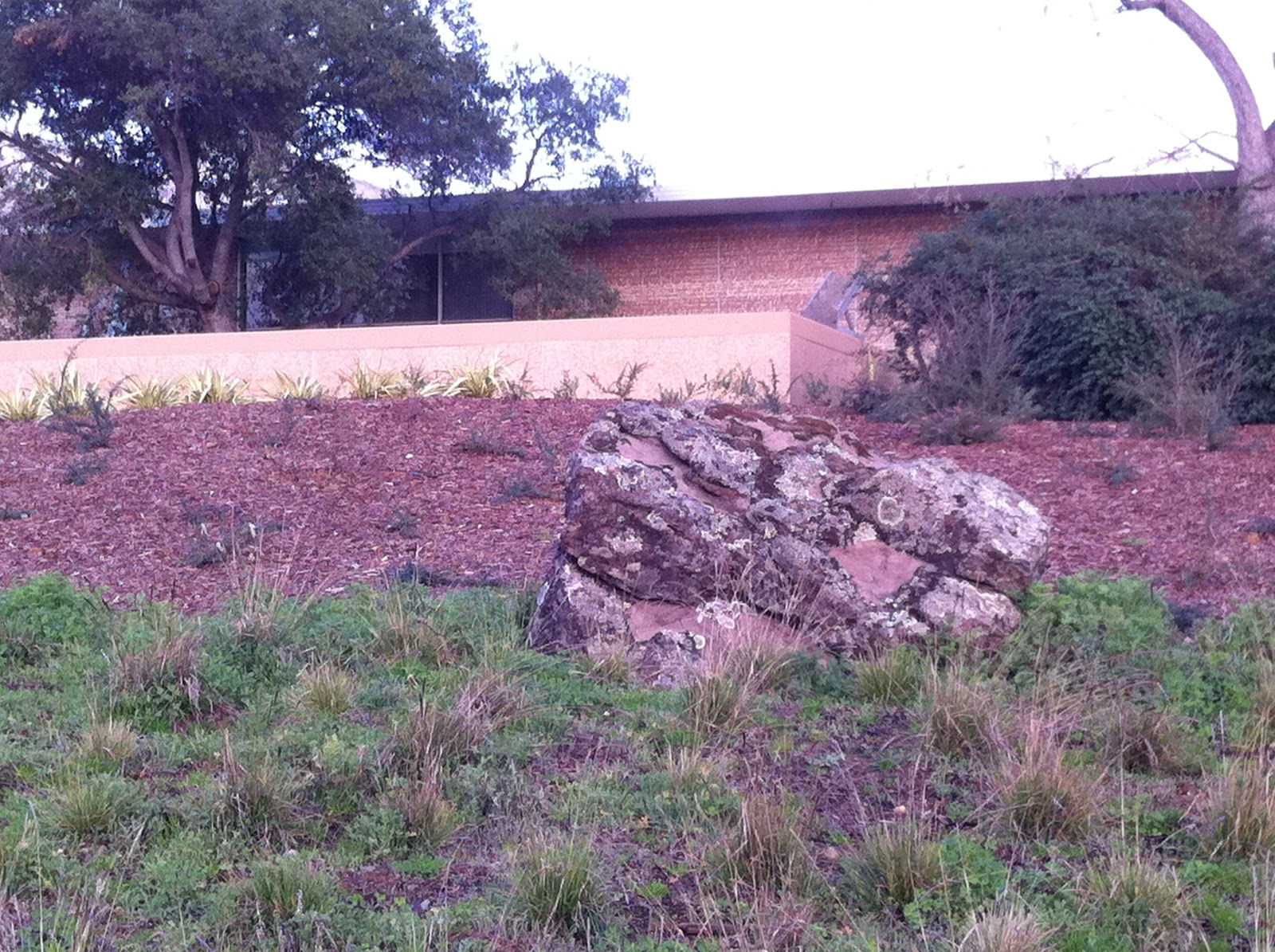
    Rock out. Boulders in the landscape are timeless sentinels, a great way to define spaces and make any area feel more natural. They look their best when they seem to be emerging from the earth — I typically specify they be buried to about 1/3 of their height. And bigger is better, perhaps because it seems impossible that such mass could have been placed by man. I was thrilled to see these ginormous specimens going in at the Hewlett-Packard campus at 1501 Page Mill Road in Palo Alto. Too bad some of them didn't go in quite far enough. The groundcover plantings may yet grow up to hide the "taper" at the rocks' bases, so no awards here — yet. But I'm watching.


    It's not all bad out there, though. A couple of winners deserve mention:


    Acer freemanii 'Autumn Blaze'

    Leucadendron species

    Muhlenbergia filipes

    Go into the light. Especially in the winter when the sun is low and weak, we have lots of opportunities to create stunning effects with plants that either reflect the light or refract it. Palo Alto has been putting in lots of Freeman maples lately, and their color is some of the most brilliant I've seen. Up in San Francisco, this set of Leucadendron from Flora Grubb Gardens positively glows in the late afternoons, as do the massings of Pennisetum and Muhlenbergia grasses at Solage resort in Calistoga. Awards all around for designing with a "light" touch.


    How to get air and water to these roots?

    Cut a pervious strip into the asphalt

    Better still, cut in a lot!

    Put down roots. It's not new this year, but I think I'll give my best in show award to the repaved parking lot at Town and Country Village, which has held up extremely well for a few years now. The best part? The permeable "slots" cut into the asphalt, set with interlocking pavers whose gravel-filled gaps allow air and water to reach the roots of the heritage Valley Oak trees that give the property so much character. It's an incredibly simple, yet creative, solution that I haven't seen anywhere else. I'll be "root"ing for its success.


    When your eyes are open, it's remarkable how much you can learn from the big guys. Please let me know if you have any lessons to share. And thanks for giving me some of your time this year… here's to continuing our education in 2011!

    Mar 3, 2009

    I Hate Being Right About This


    Rain or no rain, it's officially a drought emergency. I hate being right about things like this.

    So: are you ready to cut your water consumption by 20%? Even before you kill your lawn, schedule a house call: water agencies in San Francisco, the East Bay, Redwood City, and most* of Santa Clara County offer free basic inspections that calculate water usage and point out opportunities for conservation both indoors and out. Santa Clara Valley Water District also is hosting a "Water Efficient Landscaping Workshop Series" including one of my favorite local designers, Alrie Middlebrook.

    *California Water Service doesn't offer house calls, but does offer free fixtures and other resources for their customers in Los Altos, Los Altos HIlls, Menlo Park, Cupertino, Sunnyvale, San Carlos, San Mateo and South San Francisco.

    And if you want to get an in-depth analysis of your landscape water use, contact a certified irrigation contractor, who will put your system through its paces and really optimize it according to detailed, standardized guidelines.

    The prospect of reducing our water use by 1/5 is about as cheering as the stock market these days. But if you've been considering changing up your landscape, this is an opportunity to do it right — and perhaps even get paid for it! With a little professional advice, you can wind up with a yard that is easy on the eyes, easy on the wallet, and easy on the earth as well.

    Feb 24, 2009

    More Rain, Please

    “unless the next six weeks deliver rains of biblical proportions, Californians will face major shortages this summer”

    So writes Kelly Zito in today's Chronicle. When I wrote about the drought a couple of weeks ago, Lake Shasta was at 31% of capacity. After two weeks more or less full of rain...

    Lake Shasta is at 32% of capacity.

    For us down here at ground level, it seems like things have really turned around. Our lawns are squishy again; trees are budding out; the rain breaks just often enough for the ground to soak it up, then starts up again. The problem — actually, the two problems — are that (a) squishy lawn at sea level doesn't translate to snow up in the Sierra, where our water comes from by the time August and September roll around; and (b) this is the third consecutive year we've had low rainfall, so the ground is simply parched — as evidenced by how fast my rain garden drains out.

    So I repeat my warning about getting water-wise: the drought is coming. Water, especially to irrigate landscapes, will be in short supply, expensive, or both. Gardeners, landscapers and homeowners will have to change the way we think. That will require no small effort, so lazy me hopes I'm wrong. But I drought doubt it.

    Feb 18, 2009

    Learning from the Big Guys, Pt. 1

    I never really take off my designer's hat, and so I'm always seeing examples of good and not-so-good designs. Two of my favorite places to look for both are corporate campuses and public works: not only do they have to satisfy technical requirements far beyond anything I'll have to deal with in a home garden, they also have the budget to do it right (not perfect, just right). If one of these megaprojects is successful, I steal what ideas I can, to scale to the residential scope and budget. And if one is failing, I feel like I've struck gold - because I can learn from their expensive mistakes without spending a dime of my clients' money.

    Prolonged rainy spells are great for pointing out problems in grading and drainage. Here's an example of what I consider a failure at the newly redesigned Caltrain station at California Avenue in Palo Alto: you can see the raised concrete planter has a drain outlet at its base. But where does that water have to go to drain away? Across a path (a wheelchair ramp, to be precise). This is, at best, an inconvenience for those of us whose shoes get wet walking through it. But at worst, it's a safety hazard no matter whether you're walking or wheeling. To compound the danger, this is below grade, where the perpetually cool and shady conditions encourage the growth of slippery algae on the wet concrete.

    To my eye, all this risk could have been prevented by simply including a drain at the base of the wall, or perhaps tying in the wall outlet to the slot drain beneath the walk. Either would have been a relatively cheap solution compared to the potential costs of the problem. I hope we never find out.

    When you're designing your landscape, remember: water will always find its way downhill. I'll let you know if the City decides to address that little fact here.

    Feb 17, 2009

    Happiness, Part II

    Twenty-four hours later, the billabong has percolated most of its contents back to the groundwater. I would guess there's about five gallons remaining here, and that's even with a steady light rain over the period.

    And that's what makes this a detention basin more than a billabong, a vernal pool, or even a rain garden: its function is to slow down urban runoff, not trap it for months, just enough to restore some semblance of the natural pace of rainfall and absorption. As such, the plantings around it don't need to be true "rain garden" types, because the area doesn't really get boggy (in fact, the California Gray Rush I tried here didn't survive the summer). I'll be interested to see whether the
    Platyglossis (Tidy Tips) I planted last year, which is more of a vernal-pool native, reseeds.

    Feb 16, 2009

    Happiness is a Full Billabong

    Now that's more like it...

    This is probably 70 gallons of rainwater from the past 2 days. I am very pleasantly surprised that the "pond" is keeping pace with the rain; Palo Alto has had close to 3 inches so far.

    Not that a rain garden is the perfect solution for everybody's front yard, but I do get a warm fuzzy feeling knowing I kept this water (a) away from our foundation and (b) out of the gutter.

    Feb 4, 2009

    Not Quite The Apocalypse… Yet

    Since I wrote last summer about the threat of drought, things have gotten worse — much worse. The Sonoma County Water Agency has announced mandatory usage cutbacks of at least 30%. In the East Bay, EBMUD has called for 19% reductions, and implemented rate increases for all usage. Bolinas has already emptied one of its two emergency reservoirs, and is limiting household usage to 150 gallons per day (repeat offenders will have their water supply cut off). The Sierra Nevada snowpack is at 61% of normal, and the state's largest reservoir, Lake Shasta, is at 31% of capacity.

    So what's a gardener to do?

    For starters, kill your lawn. Turf is by far the thirstiest aspect of your landscape, and even if the water is available it's going to cost you an arm and a leg to keep it green.

    Next, audit your landscape water usage. Hire a certified irrigation contractor or irrigation auditor to ascertain whether your system is using more water than necessary. Are there leaks in your pipes? Could your run times be shortened? Could those spray heads be converted to drip? The investment will pay for itself.

    While you're optimizing your irrigation, optimize your plantings as well. Make sure your plants are grouped together by water need — ferns with dogwoods, sages with grasses, Carex well away from Ceanothus. While you're at it, take another look at some of your thirstier specimens: do you really need those hydrangeas and roses?

    Finally, when every drop counts, it makes sense to save every drop you can, and a rain-catchment system is one of the best ways. We've seen the traditional rain barrel any number of different ways, but there are a few other options available now, such as the Rainwater Hog which can mount either vertically against a wall, or horizontally beneath a deck.

    Don't forget, Santa Clara County is offering rebates for water-thrifty planting and irrigation updates. But whether you take advantage of the rebates or not, the time to make your garden water-wise is now.

    Sep 27, 2008

    Et Tu, Palo Alto?


    I was feeling a little righteous when I castigated Carlsbad for the gross mismanagement of water there, but my own town is no better. Here's the scene at a corporate site at Foothill/Hillview at 2:50pm today.

    Sigh...

    Aug 30, 2008

    Water in the Landscape

    California is officially in a drought (although personally I suspect this is our normal climate and those other years were just extra wet). Some water districts have implemented mandatory rationing, while others are still able to request voluntary cutbacks… for now. But it behooves all of us to be conscious of our water use, and water-wise landscaping is an easy first step.

    The Santa Clara Valley Water District has created a very nice booklet on landscape planning, from layout to planting and of course irrigation practices. Their site also offers a list of water-wise plants, not exhaustive but certainly robust enough for most of us. And, if you needed any more incentive, the district is offering a landscaping rebate of up to $1,000 to replace your thirsty turf lawn with more efficient plantings, or an irrigation rebate of up to $1,000 to install drip systems, rain sensors and other "smart" irrigation products.

    The Association of Professional Landscape Designers also has issued guidelines to keep its members cognizant of practices that not only reduce irrigation needs, but also respect natural cycles by encouraging stormwater detention and holistic ecological planning. The American Society of Landscape Architects has also issued some pointers on conserving water as well as greening your home overall. And the California Landscape Contractors Association offers not only tips on how to "reduce your use," but also resources for finding certified water managers to install or optimize your low-water landscape.

    The threat of a serious and prolonged drought is an abrupt wake-up call for all of us, and the options for adapting to it can be overwhelming. Start by speaking with your landscape professional — designer, architect, or contractor — and you'll get both reassurance and real solutions to save water and save money.

    May 13, 2008

    Baby, It's Hot Outside

    Even as East Bay MUD proposes its first water-rationing measure in two decades, this week temperatures are expected to soar toward the century mark.

    For your garden, this means get a head start (i.e., now) on keeping your plants hydrated. If you're irrigating with a spray system, see whether your controller can be programmed to repeat cycles — so that rather than watering once for ten minutes, which may deliver more water than the soil can absorb at once — your system waters each zone once for five minutes, then repeats the cycle for another five — so Zone A is absorbing while Zone B is receiving. If you're not sure how much water your plants should be getting, get to know your local Master Gardener; you can also extrapolate some good information from publications developed for commercial growers.

    If you're irrigating with a low-flow (drip) system, you will want to increase the length of each cycle and/or add a "syringe" cycle in the middle of the day, effectively giving the plants a drink when their transpiration rates are highest.

    You'll also want to make sure all that precious water stays in the soil, where the plants can actually get it, rather than evaporating into thin air. The most effective way to do this is with a generous layer of mulch. Most often we think of mulch as fir bark, which is ground to various consistencies (or shredded into "gorilla hair").

    However, there's more than one way to mulch: compost is wonderful, adding nutrients to the soil even as it holds water in; and even pea gravel is effective (although pricey and doesn't decompose like organic matter). Some municipalities even give away free compost to residents. The key with mulch is to apply it generously (I prefer a depth of least 3 inches) and regularly. Remember, organic matter like bark and compost break down over time; so plan to reapply an inch or so at least a couple of times a year.

    There are plenty of other considerations in creating "water-wise" gardens. The California Water Service has some good resources, including a list of drought-resistant plants; if you've got good tips for getting your garden through the heat, please let me know!

    Apr 22, 2008

    (Happy) Earth Day

    Hooray. It's "Earth Day." One day, 24 hours, for us to be more aware and appreciative of the Earth's environment.

    Woo hoo.

    Never mind that the other 364 days of the year we're driving our SUV around town, alone and comfy in our captain's chair.

    Or that we still leave the water running while we wash our hands with antibacterial soap.

    Or that our salmon are now in as much trouble as our tuna.

    I put honey in my tea today and was confronted by two unwelcome thoughts:
  • If this isn't "organic" honey, what crap pesticide residue am I drinking now?
  • When the bees go extinct, how will I put honey in my tea?

    Across the street, the neighbor's sprinklers spray well beyond the curbside planting strip, flooding the gutter and soaking the cars parked there. Then the gardener fires up his gas-powered leaf blower, creating great clouds of dust and grass clippings and pollen that immediately adhere to the wet cars. I am not making this up.

    It seems to me that we, as a society, have gone mad. We are pathological, behaving in ways that clearly harm others, if not directly ourselves. We are compulsive, unable or unwilling to modify our behaviors even when it's made clear that they are destructive. And we are delusional, somehow believing — despite overwhelming evidence to the contrary — that our actions either don't have consequences or will be mitigated by someone else.

    It's been about two years since Al Gore's An Inconvenient Truth made us all wince just a little bit. And yet the troubles have been on people's lips for more than 15 years — I caught Batman Returns on TV over the weekend, and even in 1992 the Penguin referenced "global warming." I understand that sometimes Hollywood can seem out of touch, but major studio releases don't make their money referencing arcane phenomena advanced only by the intelligentsia.

    I was going to write today about a few things we all can do to help our planet, our neighbors, our children. Little things, things you might actually do, like converting your lawn to low-water plantings, not like converting your SUV to biodiesel. But honestly, we've known we're in trouble for, let's conservatively say, a decade. What have you changed in that time? Have you converted your lawn to low-water plantings? Have you stopped buying products whose manufacture kills the environment? Do you recycle and/or compost most, if not all, of your waste?

    If you have, great. I applaud you. Tell us all about it, if for no other reason than to help us sustain our delusion that someone somewhere is fixing the problem we're creating. But when my clients still demand lawns that no child will ever play on… when "my" contractors still install spray irrigation because drip is too difficult… when I myself still drive my SUV around town, solo… I think perhaps the problem is outpacing the fix.

    So, seriously: what are we going to do about it?
  • Apr 12, 2008

    Green Building Comes Home

    If you're planning a construction project here in Palo Alto later this year, odds are you're going to be held to a higher standard than ever. As reported in the Palo Alto Weekly, a proposed building ordinance will require that residential construction ultimately comply with the "GreenPoint Rated" checklist developed by California's Build It Green initiative; and that commercial projects meet national LEED standards.

    On the home front, here are some of the items Build It Green includes on their landscaping checklist:
  • Construct Resource-Efficient Landscapes
  • Use Fire-Safe Landscaping Techniques
  • Minimize Turf Areas
  • Plant Shade Trees
  • Group Plants by Water Needs (Hydrozoning)
  • Install High-Efficiency Irrigation Systems
  • Add Compost to Promote Healthy Topsoil
  • Mulch All Planting Beds
  • Use Salvaged or Recycled-Content Materials for Landscape Elements
  • Reduce Light Pollution
  • Collect and Retain Rainwater for Irrigation

    The proposed ordinance is likely to take effect in July, with a phased implementation (e.g. home builders will only have to earn 75% of the necessary points within the first two years) to allow time to master the new requirements. But whether you're a local homeowner, a builder or a contractor working in Palo Alto, the political landscape is about to dictate major changes to your project's landscaping. If you have questions about what's ahead, I'd be happy to be your local green guide.
  • Apr 1, 2008

    The Worst Tree Ever

    You know that beautiful, majestic, mature redwood tree in your neighborhood — maybe even in your yard? The one that's the pride of your community?

    Kill it.
    Cut it down.
    Do it now.

    "What?!" He's gone mad, you're saying. There's no — how could — what??!!

    But the disturbing fact is, a grown redwood sucks up more water each and every day — 500 gallons or more! — than any other garden plant, including the oft-demonized lawn. Even the most water-unthrifty among us, spraying the lawn (and sidewalk and gutter) 10 minutes every day at 25 gallons per minute, might spend 250 gallons a day… but not 500 per plant.

    And that's not even to mention that redwoods, like wolves, are hardly solitary creatures. They grow in groves, and if you've ever been to Muir Woods, you've seen it: as soon as one tree dies, a "fairy ring" sprouts up around its base. One down, five take its place. So now instead of 500 gallons per day, we're talking 2500 gallons. Do you want that water bill? I don't.

    Will your garden be next?But it's not just water. The fairy ring is a perfect example: is there any better definition of a noxious weed? I mean, we curse the fluorescent yellow oxalis this time of year, but in a few months it's gone. We lament the smothering of our native hillsides by scraggly Scotch broom, but at least we can still see the hillside. A fairy ring gets going in your next door neighbor's lot, you may as well get yourself an old Underwood and start composing manifestos.

    Plus, redwoods create fire danger. Their copious duff and bark are rich in tannins, which suppress not only weeds but also fire, which would be all well and good except that, as the wise people in our government who are paid to think these things all the way through know, the West's wildfires are becoming more catastrophic because there are fewer small fires occurring, so that when a fire does get going, it's got more and larger trees (i.e. more fuel) and spirals out of control much faster.

    El Palo not-so-Alto-anymore
    Quite honestly, redwoods are such a menace it's difficult to understand why they're the state tree of otherwise enlightened California — or why my own fair city not only hasn't cut down its decrepit namesake and renamed itself South Menlo or Steve's Town or something actually worthy of its citizenry, but actually has accorded these monsters "heritage tree" status; and so protected, they'll continue to grow and consume even more water — leaving even less available for the rest of us in these near-drought times.

    Look: I appreciate the spirit of well-meaning groups like Save The Redwoods and Sierra Club and The Nature Conservancy, who valiantly endeavor to preserve the few remaining places that are so pristine it's almost a transcendent experience to visit. It just breaks my heart they so willingly ignore no less than Time magazine's reporting that "redwoods create their own microclimate" (which explains why gardening around them is an ambitious affair at best) to lionize the legendary Sequoia as if its utter domination of the landscape is somehow a good thing. "Drippy, dark and closed in," says one of California's foremost native plantsmen of a Sequoia habitat. "Cut the forest down and you usually get Northern Coastal Scrub."

    Sequoia-free = tabula rasaThe irony is that once a redwood is removed, instantly it becomes apparent how much light and air are available to the gardener and the garden. Roses can grow where only ferns dared try; moss and musty odors disappear overnight; our dream of a water-wise garden actually has a chance of becoming a reality.

    Still want a tree in that spot? Now you're free to choose. Plant a mighty oak! (Uh, well, except that oaks can drink 250 gallons a day and still become overbearing monstrosities that can never be cut down. Nevermind.) OK, plant a… willow! Or a birch! (Um, wait, those are both riparian species, so they'll suck up all your water and invade your sewer line.) A jacaranda, then! (Actually, it gets a little cold here for those to really thrive.) Jeez, a magnolia! (Yeaahhhhhh… despite their ubiquity, they actually heave hardscape like crazy and look pretty bad without constant moisture and humidity. Not a good choice for our summers.)

    Look, what's wrong with you?! Why are you so hung up on specifics?! Once that damn redwood is gone, you can do whatever you want! Okay, I'll take the initiative: so that we can write the last chapter of this nightmare, I'll personally contact every city council on the peninsula, as well as the California EPA, and implore them to rescind the redwoods' heritage tree status.

    Just… not today.

    Jan 5, 2008

    Benefits of a Rain Garden

    The whole reason I'm installing my vernal pool, or rain garden, or whatever it is, is to restore a little bit of natural ecology as well as reduce the amount of urban runoff into our storm drain systems.

    "But, John," you protest, "how much runoff are you really eliminating with your little 110 square foot pond?"

    Glad you asked. Hey, math time again!
      110 square foot pool surface area
      * 1 foot average pool depth
      __________
      110 cubic foot pool volume
      * 7.48 gallons / cu. ft.
      __________
      822.8 gallon capacity
      * 66% full
      __________
      543 gallons


    That's right, in Friday's storm my little pond held well over 500 gallons of rainwater — not counting what it percolated during the storm — and ultimately released it back to the earth rather than letting it flow out to the gutters or dumping it out at my home's foundation, whether into a French drain or not.

    543 gallons and counting? I'm feeling pretty good about myself right now.