Showing posts with label integrated pest management (IPM). Show all posts

Mar 13, 2009

Sights, Sounds and Synthetic Compounds of Spring

The sun's been shining for a week now, so it's officially spring around here no matter what the calendar or thermometer say. If you need further proof: both my neighbor and I busted out our lawn mowers in the last week for the first time in months; my broccoli, which I swear I just planted, has bolted and gone to flower; the annual weeds like dandelion and Italian ryegrass have kicked it into overdrive and set seed already.

In other words, this is the time of year when our gardens are most likely to get away from us. A little rain, a little sun, a little extra warmth, and everyone's feeling happy. But for those of us who desire to chaperone the party a bit, this can also be a very challenging time, and it's when we are most likely to break out the RoundUp, Corry's Slug & Snail Death and other chemical assistants to give us a hand.

As much as I prefer gardening organically, I recognize the realities of modern life; I also much prefer a handwritten note to email, or reading the newspaper to reading a blog, yet here we are. I also will not be out in my yard hoeing away every last ryegrass seed, so chemicals can be a "technology" I use to achieve my goals with the time and energy I do have.

Like any tool or technology, RoundUp is not inherently evil. Sure, it may have been created by evil men (although I doubt it), it may harm the earth and its inhabitants, and there's no question that it's integral to the morally corrupt business strategies of companies like Monsanto. But on its own? RoundUp is just a chemical compound, and it's up to you and me to use it responsibly.

The chemical isn't the problem. The problem is, we lose sight of our real goals (a vibrant, healthy garden environment) in the glare of short-term fixes. Add to that the urgency panic inspired by a garden quickly outpacing us, and our tendency is to grab the nearest solution and drench our problems with it. But if we stop, take a jasmine-scented breath, and think, we can actually make choices that fulfill our short- and long-term needs. For weed control, try repeated applications of undiluted vinegar, or boiling water, or boiling undiluted vinegar (after a reality check). For slugs and snails, an iron-phosphate compound such as Sluggo is extremely safe (and more convenient than beer traps).

There is no shortage of organic gardening blogs out there, as well as Cooperative Extension offices with expertise far beyond what I'll ever accrue, including strategies for integrated pest management. Start there, then take another look at the garden you really want to have... does RoundUp really belong in it?

Apr 22, 2008

(Happy) Earth Day

Hooray. It's "Earth Day." One day, 24 hours, for us to be more aware and appreciative of the Earth's environment.

Woo hoo.

Never mind that the other 364 days of the year we're driving our SUV around town, alone and comfy in our captain's chair.

Or that we still leave the water running while we wash our hands with antibacterial soap.

Or that our salmon are now in as much trouble as our tuna.

I put honey in my tea today and was confronted by two unwelcome thoughts:
  • If this isn't "organic" honey, what crap pesticide residue am I drinking now?
  • When the bees go extinct, how will I put honey in my tea?

    Across the street, the neighbor's sprinklers spray well beyond the curbside planting strip, flooding the gutter and soaking the cars parked there. Then the gardener fires up his gas-powered leaf blower, creating great clouds of dust and grass clippings and pollen that immediately adhere to the wet cars. I am not making this up.

    It seems to me that we, as a society, have gone mad. We are pathological, behaving in ways that clearly harm others, if not directly ourselves. We are compulsive, unable or unwilling to modify our behaviors even when it's made clear that they are destructive. And we are delusional, somehow believing — despite overwhelming evidence to the contrary — that our actions either don't have consequences or will be mitigated by someone else.

    It's been about two years since Al Gore's An Inconvenient Truth made us all wince just a little bit. And yet the troubles have been on people's lips for more than 15 years — I caught Batman Returns on TV over the weekend, and even in 1992 the Penguin referenced "global warming." I understand that sometimes Hollywood can seem out of touch, but major studio releases don't make their money referencing arcane phenomena advanced only by the intelligentsia.

    I was going to write today about a few things we all can do to help our planet, our neighbors, our children. Little things, things you might actually do, like converting your lawn to low-water plantings, not like converting your SUV to biodiesel. But honestly, we've known we're in trouble for, let's conservatively say, a decade. What have you changed in that time? Have you converted your lawn to low-water plantings? Have you stopped buying products whose manufacture kills the environment? Do you recycle and/or compost most, if not all, of your waste?

    If you have, great. I applaud you. Tell us all about it, if for no other reason than to help us sustain our delusion that someone somewhere is fixing the problem we're creating. But when my clients still demand lawns that no child will ever play on… when "my" contractors still install spray irrigation because drip is too difficult… when I myself still drive my SUV around town, solo… I think perhaps the problem is outpacing the fix.

    So, seriously: what are we going to do about it?
  • Feb 18, 2008

    Public Radio Sounds Green

    Today's edition of Forum on KQED featured a most informative discussion of the Light Brown Apple Moth, and the recent announcement of California's plans to spray pesticide to eradicate it.

    In other news, yesterday's edition of Fresh Air featured a most informative interview with the author of Banana: "a primer on the expansive history — and the endangered future — of this seedless, sexless fruit."

    Apr 26, 2007

    Why I Didn't Send You Flowers

    Wait! Is that the drone of helicopters? Does anyone else smell DDT?

    We're under quarantine again, this time courtesy of the light brown apple moth (Epiphyas postvittana), an invasive species native to Australia. This innocent looking little guy (maybe it's the nail through his neck) destroys, stunts or deforms young seedlings; spoils the appearance of ornamental plants; and injures deciduous fruit-tree crops, citrus and grapes. All in all, the LBAM (can we call him Bam-Bam?) has a taste for some 250 species of plants.

    The quarantine was implemented on March 22, about a month after a retired entomologist found a couple of LBAMs in his backyard. Bam-Bam has been established in Hawaii for a while now, but this is his first appearance on the mainland. Santa Clara county was added to the quarantine zone on April 20, after being detected in Palo Alto and Los Altos a week earlier.

    Because Bam-Bam doesn't have a very long flight range, he's mastered the art of hitchhiking. The California Department of Food and Agriculture was quick to develop this brochure to explain how you can thwart his travels. The good news is, Bam-Bam is also vulnerable to organic controls, including pheremone disruption, Bacillus thuringiensis and parasitic wasps.

    While the state rushes to keep LBAM from spreading (which would be, um, BAD for our sizable agricultural exports), the rest of us can keep a lid on our green waste, not bring host plants (i.e. plants, period) to non-quarantined areas, and call CDFA if we see Bam-Bam.

    After, of course, giving him a one-way ticket ¡STRAIGHT TO HELL! with a nail through the neck.

    (Thanks to Ron and Joe for their reporting at SFGate.com.)

    Jul 27, 2006

    Well, Back to DDT...

    Maria Cone reports in the Los Angeles Times: "Alarmed that popular insecticides that end up in urban streams are killing tiny aquatic creatures, California's pesticide agency is conducting a review that is likely to lead to restrictions on many products used on lawns and gardens.

    "The chemicals, pyrethroids, are man-made versions of natural compounds in chrysanthemum flowers. ...last fall, a UC Berkeley scientist reported that pyrethroids are polluting streams in Northern California suburbs, wiping out crustaceans and insects vital to ecosystems. "

    Too much of a good thing, indeed. Pyrethroids have been popular because they are derived from natural sources: "safe enough to eat!" I remember some pitchman or other saying, as he chomped into a just-sprayed apple.

    (Never mind that the pitchman now resides in an asylum, under observation for paranoid homicidal episodes brought on by neurological dysfunction. Sheer coincidence.)

    Seriously, it's a tricky proposition. We value the beauty and diversity of nonnative species, but we upset the natural ecological balance when we import them. So as these plants prove a little too attractive to whiteflies, thrips , mealybugs and the lot, we turn to chemicals -- hopefully "benign" ones -- to control the bad guys, not considering that everything in nature has some connection to everything else. (Natural or not, chrysanthemum toxins were never intended to enter waterways en masse.)

    To further complicate matters, pyrethroids have also been a useful weapon in a more noble fight, the protection of European honeybee colonies from the predatory varroa mites that are decimating populations of these pollinators. (Plus -- how 'bout a big shout-out to evolution?! -- the mites are developing resistance to the pyrethroids.)

    In this case, the state expects to regulate or even abolish the use of pyrethroids. But our addiction to nonnative species isn't going to end -- municipalities aren't going to rip out their stands of Loropetalum and Magnolia to replace them with native plant communities. And you can be sure that the companies that make pyrethroid pesticides aren't going to roll over quietly; as the Times reported, "a spokesman for CropLife America, representing pesticide manufacturers, said Thursday that the companies were unaware of California's intentions but will cooperate with its requests. He said the industry does not agree that there are toxicity problems … 'The valuable contributions that pyrethroids make through agricultural and urban uses are many and these benefits need to be considered'."

    My guess is, the chemists will develop so-called "solutions," either cultivars or pesticides, engineered to be as "safe" as everyone's new favorite artificial sweetener. Of course these will open an entirely new can of worms -- assuming the worms haven't already been killed off by pesticides, herbicides, and fertilizers -- and we'll be riding this merry-go-round again all too soon.

    Apr 26, 2006

    Liquefied Toads?!

    Oh yeah, I want to eat tree fruit that was fertilized with liquefied toads.

    From Landscape Online:
    "The cane toad, introduced to Australia from Hawaii in 1935 to control two beetle species feasting on sugar cane have spread south and west across the continent in great numbers. The toad is an invasive species, attaining high population densities and consuming large numbers of invertebrates.

    "Cane toads have venom-secreting poison glands on each shoulder where poison is released when they are threatened. If ingested, this venom can cause rapid heartbeat, excessive salivation, convulsions and paralysis and can result in death for many native animals.

    "Frog Watch, a conservation group in the Northern Territory that seeks to greatly reduce the cane toad population, approached Moeco Pty Ltd. with the idea to produce a fertilizer from the unwanted pests. A preliminary batch of cane toad fertilizer was processed in February 2006 from 200 kilos of frozen toads. Greening Australia will test the fertilizer. The manufacturer asserts the liquefied toads, an organic goop blue in color, is a high potassium fertilizer good for all types of fruit trees and recommended for flowering plants to enhance their size and coloring."

    Jan 19, 2006

    Going Against Nature?

    One of the barometers I use to gauge a design's appropriateness is how much effort is required to keep the landscape looking and performing its best. I'll be the first to admit that I don't know all the details about this situation described by the L.A. Times/Associated Press--and that commercial agriculture is completely different from ornamental horticulture--but if you can't keep an ecosystem alive without massive amounts of fertilizer and pesticides, is it really an ecosystem... or just a bunch of plants on life support?

    "Iraqis Struggle With Tree Care"

    "Abid Ali Ubaid and three of his sons tend citrus, dates, vegetables and livestock. The tall date palms, some 200 years old, are not producing well. Disease is killing off the orange trees. The harvest has dropped by two-thirds, from about 300 pounds a year to 100.

    Abid Ali Ubaid digs up a dying orange tree on land he rents in Baghdad’s affluent Karada district. The family says it made virtually no profit last year. Photo: Saad Khalaf

    “'Last year we made 1 cent profit,' said Basim Ubaid, 24, one of Abid Ali’s sons.

    "The trees’ decline has many causes, Basim said in January. Government handouts of fertilizer and pesticides have stopped. The municipal water supply dried up. The irrigation water they now pump directly from the Tigris is polluted. Restrictions on flying over Baghdad have limited aerial pesticide spraying.

    "On a positive note, American troops are leaving the trees alone. Despite attacks mounted from date groves, soldiers and Marines are not adding chain saws to their arsenal of weapons.

    "'If you went in and destroyed palm groves, you’d be doing the same thing as Saddam Hussein,' Capt. Michael Adams told the Associated Press.

    "Adams was involved in a project that used aircraft to spray pesticides back in 2004.

    "Abid Ali, 50, sprays 630 trees by hand now. To get to the top, he wears a handmade sling of stiff cable and leans back against it like a telephone lineman.

    "Ubaid’s son Basim, who dropped out of school in the fifth grade, sees no hope for his family unless the government restores utilities and assistance to farmers.

    “'Pests are out of control,' he said. 'We can’t manage them. The minister of agriculture will have to give us fertilizer or he can take care of it himself.'”

    Oct 10, 2005

    Much Ado About Mulch

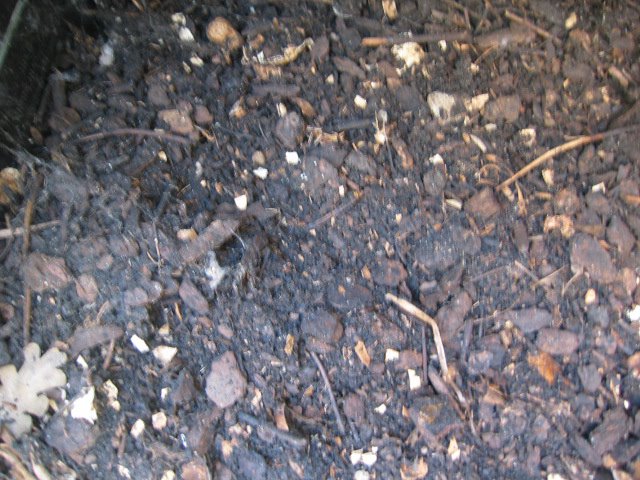
    Although you wouldn't know it to look outside, it's about to get rainy around here. Which means this is an ideal time to lay down a good, thick layer of mulch on your garden. No matter what material you use -- redwood nuggets, shredded fir bark, or organic compost -- it's recommended to keep at least 2" to 4" atop your soil. This helps suppress weeds (which won't get enough sunlight to germinate); retain moisture (which can't evaporate so readily); and, as tends to happen in dark, damp places, encourage the growth of fungus.

    In particular, we use mulch to encourage mycorrhizae, a group of fungi that develop symbiotic relationships with the plants around them: in exchange for gleaning micronutrients from the plants, the fungi deliver water, oxygen and other nutrients to the plants. And because the mycorrhizae can grow into webs spanning hundreds of feet or more, plants in mycorrhizae-rich environments have access to far more food and water than might be delivered to just their own root zone. This makes mycorrhizae particularly valuable to native plant species, which have adapted to grow in lean soils and dry conditions. But no matter what your garden is growing, or when you plan to plant, it's a good idea to pile on the mulch now.

    Jun 30, 2005

    Jewels on the Wing

    [Note: Verdance clients originally received this article in May, as part of our free monthly newsletter on gardens and gardening. To subscribe to the newsletter yourself, please register at our site.]

    Recently I read that the number of monarch butterflies migrating from North America down to Mexico has fallen an astonishing 75% -- even after 75% of their population already was lost to a freeze on their overwintering habitat in 2002. At this rate, monarch extinction seems likely in years, not decades or centuries, raising the gloomy prospect of a future when our children or grandchildren never get to delight in these winged jewels.

    Studies of why butterfly populations are declining indicate a complex web of causes including deforestation, climate change, and pesticides. Whatever the reasons, though, we each can still do small things to slow the decline.

    The best way to attract adult butterflies is to plant a garden that includes the vital milkweed plus sunflowers, zinnias, marigolds, phlox, petunias, butterfly bush, black-eyed susans, lilies, cosmos and daisies. Even without such an intensive habitat in our yard, most of us can integrate a few of these plants -- and collectively create a butterfly garden that spans acres.

    It's also important to encourage butterfly caterpillars. The Sunset Western Garden Book lists plants whose foliage is good caterpillar food; there is a broad palette to choose from (broccoli -- who knew?), and it's easy to tuck a few into any garden. If you would like suggestions on butterfly plants whose foliage or flowers will complement your existing landscape, it would be my pleasure to help.

    Perhaps the most important step you can take is to avoid using pesticides -- even "natural" ones such as Bacillus thurigenesis (B.t.) -- that kill indiscriminately. Always try the most benign and pest-specific solutions first: for instance, a sharp jet of water knocks aphids off of leaves and flower buds, and non-toxic oils of neem, garlic, mint or clove discourage ants, mosquitoes, leafhoppers and thrips.

    And above all, appreciate the graceful acrobatics and fragile beauty of every monarch, anise swallowtail, and mourning cloak you see. Currently a spectacular migration of painted ladies is making its way through the Bay Area; taking the time to notice them will create a warm place in your heart that will endure long after the last butterfly has fluttered by.

    [Update: there are quite a few swallowtails floating around, and on 6/10 my client in Berkeley reported, "Amazingly we have hundreds of Monarchs hanging out in our neighborhood this year. First time we have seen it since we have lived here. Has lasted three days so far. Kind of cool."]

    Jun 27, 2005

    A Fungus Among Us

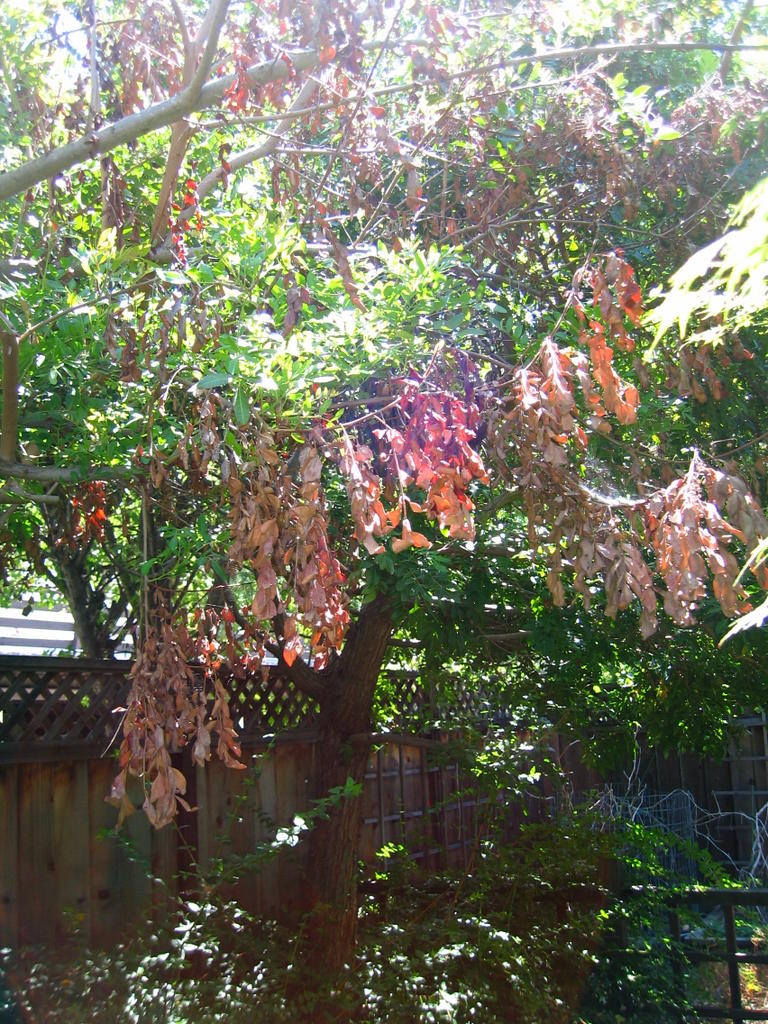
    One of the Pistacia chinensis (Chinese pistache) trees planted in the parkway in front of our home has been in a bit of a slump. Last year it lost a few leaflets a little early; this year it's been losing a lot more — a lot earlier.

    At first I wondered whether maybe the tree was just a little stressed (aren't we all?). Then, I thought, maybe its roots were bumping into the remnants of the allelopathic Juglans nigra (black walnut) that used to live there; but that didn't make sense, because that tree was long gone even before it was taken out. Then I came across a diagnosis that, unfortunately, fits: verticillium wilt.

    Now, I knew that Verticillium could be a problem here. Every nursery carries "VFN" tomatoes and strawberries, for instance, bred to resist Verticillium and Fusarium fungi and nematodes. And I've already had first-hand experience with Verticillium, which is steadily taking out one of our Schinus molle (Brazilian pepper) screening trees (even though the tree is putting up enough of a fight that every year I hope this might be the year it impersonates Lazarus). But come on now... our street trees?! That's just not fair.

    This is the problem with urban soils: they have been so heavily used, and so poorly managed, over the years that there's just no telling what has taken up residence in them. Our neighborhood, for instance, used to be a pear orchard; so it's actually not surprising when our apples and pears (fruiting and ornamental alike) wither and brown from fireblight, or our strawberry plants turn to dust seemingly overnight from Verticillium.

    Worst of all, there's little evidence on the surface as to what lurks below. Not 10 feet from our infected pepper tree, a patch of volunteered strawberries is thriving. And once the fungus is there, it's there to stay. That's why I decided to include soil testing among Verdance's suite of services, so we can know what to expect before we call for that specimen Aristocrat pear (or that all-important curtain of Schinus... darn).

    I'll keep crossing my fingers that our pistache is simply stressed after all. But frankly, it's not the only one.