Showing posts with label design principles. Show all posts

Sep 25, 2014

It's Raining! (Now What?)

A reprise of a post from a few years ago seems appropriate given today's welcome visitor… I originally wrote this on January 18, 2010; and while some names and statistics may have changed since then, the core message remains the same.—JB

It's been hard to miss the message over the past year that we're in a drought. And Californians have responded remarkably well: residential water use was reduced by 9.4% in Santa Clara County, 12% in Los Angeles County, and up to 25% in San Diego County from previous periods. I still see far too many gratuitous lawns, thirsty "exotic" plants and wasteful irrigation systems. But on the whole, we're at least trying to handle our water.

So the next place to look is, naturally, increasing our supply. And on the cusp of a major El NiƱo week like the one currently forecast for the Bay Area, the opportunities seem abundant. So why isn't everyone harvesting rainwater? To understand why it's not quite that simple, let's do a little math:

    First, let's assume we're in for nine inches of rain — that's 3/4 foot — over the next week or so.

    Second, let's assume we can harvest that rain from the roof of our detached 2-car garage, which has a roof area (equals footprint) of about 20 feet by 20 feet.

    So if we catch every drop that falls on our roof, we would harvest 20' * 20' * 3/4' = 300 cubic feet.

    Using a handy-dandy volume converter, we find that 300 cubic feet equals 2,244.156 gallons.

Holy crap! Seriously?! More than two thousand gallons? That can't be right.

    Well, actually, it isn't right. Because we won't catch every drop. Some will splash away, some will get trapped in the gutters, some will leak out. So a capture rate of 60% is usually considered reasonable, and our potential volume actually is 2,244.156 * 60% = 1,346.494 gallons.

Holy crap! Seriously?! More than thirteen hundred gallons?

Yep. And unfortunately, that huge number is less than 5% of the annual water needs of a 1,000 square foot lawn. Never mind that if you're serious about water conservation, you don't have a 1,000 square foot lawn; are you getting a sense of the quantity of water we're talking about? Say you did have a 20'x50' patch of grass: 1,346 gallons of rainwater would irrigate it for all of about two weeks. For the year you'd need twenty times that, or around 27,000 gallons.

Which raises another issue, specific to Mediterranean climates like ours where most of the rain comes in one season, as opposed to throughout the year: storage.

We get most of our rain during the winter, when plants are dormant and evapotranspiration rates are low. We don't need the captured rainwater now. We need it six to nine months from now, when skies are sunny and the ground is parched. Even if you have no lawn and your xeric garden only needs 1,300 gallons, where do you store what you've saved?

Rain BarrelRainwater PillowRain BoxRainwater HogThere are in-ground cisterns, which may be large enough but are pricey and complicated to install. There are classic, above-ground rain barrels, which are bulky and difficult to link together for additional capacity. There are interesting systems like the Rainwater Pillow which can efficiently store 1,000 gallons or more, but may not be ideal for exposed outdoor locations. And there are modern above-ground tanks such as the Rain Box and Rainwater Hog, which link together with slim rectilinear profiles that use space efficiently but can become pricey.

How pricey? The Rainwater Hog sells in the neighborhood of $500 per 50-gallon tank. To catch 1,346 gallons requires 27 tanks, or $13,500. The Rain Box is more economical, at about $250 per 75-gallon box. But that's still 18 boxes, or $4,500.

Even if cost isn't a consideration, space may be. The Rainwater Hog has such a slim profile — just 20" wide by 10" deep — that it can be mounted not only vertically against walls, but also horizontally, e.g. beneath a deck. But no matter how you set them up, 27 tanks would take a lot of room: far more than the 20' wide wall of our two-car garage. The Rain Box is bigger, about 24" wide by 20" deep, and not designed to mount horizontally; so 18 boxes would need at least 36', or almost two full walls of the garage.

I don't mean to discourage anyone from catching and reusing every drop possible. Even if your "rain barrel" is a garbage can, that's 20 or 30 gallons you don't need to draw from a reservoir. But it won't be your only solution, and in fact might raise more questions, e.g. what do you do with the overflow? We all can install green roofs, detention basins and porous paving, which will help the rain get into the groundwater where it actually can do some good. But these solutions aren't the same as storage; and they're not cheap, either.

I guess my point is that it ain't easy to save the world. It's probably not economical, and you probably won't get your money back. Serious rainwater harvesting requires some serious commitment, and we're not all there just yet. But even if you're not ready to shell out thousands of dollars to store thousands of gallons, you have plenty of other options. Maybe you can swap out your lawn for a delightful garden of unthirsty plants. Maybe you can mulch those plants with 3" of compost instead of leaving the soil bare. Maybe you can redo your driveway with pervious pavers instead of asphalt. Maybe you can take shorter showers or make other changes that reduce your water footprint.

Maybe you can't do much; but you can do something. And what better time to start than now — while there's a break in the weather?

Jun 18, 2011

Learning from the Big Guys, Pt. 7

It's been an incredibly busy year so far, leaving me with lots of thoughts swirling around in my head but precious little time to put them in writing. But my daily travels take me past a few examples of poor landscape planning, and I'm never too busy to learn from the big guys. Today we examine some examples of what happens when the age-old rule "right plant, right place" is broken.

It's a great idea to plant tall trees on the south and west sides of a building. They help shade the structure and reduce heating costs, especially in a sun-drenched climate like Palo Alto. It's also a great idea to use native species such as the coast redwood, Sequoia sempervirens. What's not such a great idea is planting a tree that wants to be 100 feet tall beneath eaves that are 40 feet high. Something has to give here, and I'm betting it won't be the building. Anyone want to make odds on how many days before this poorly-planned tree is removed?


 The Palo Alto JCC is a wonderful example of modern urban infill. It's got intimate courtyards and simple but effective stands of plantings that make it a great space for people. Unfortunately, the designers consistently underestimated the demands of the Center's vehicular traffic, specifically the turning radii cars and trucks would need. Perhaps the planners were simply optimistic that the center would attract fuel-efficient small cars rather than large trucks or SUVs; however, even the average minivan (of which the family-oriented Center attracts plenty) is challenged by turns that are too sharp and lanes that are too narrow. As a result, a couple of walls in the parking garage have been damaged by car bumpers, and curbs have had to be cut or removed and reconfigured. Orange safety cones are proliferating, and overall the traffic areas are looking like a patchwork of temporary fixes — except they're not temporary.

Outside, the entry driveway circles around a center median that is not contained by a raised curb. On the one hand, this is useful because it allows the median to receive stormwater from the surrounding pavement, an effective environmental strategy (the Center earned LEED Silver certification). On the other hand, the absence of a curb means that vehicles can — and do — cut the turn and drive through the planter. This means more orange cones, and a chronically muddy mess that always seems to hold standing water. It's too compacted to sustain plants, and they'd probably get driven over anyhow. The lesson here? Turns require far larger radii than we may think: at least 15-20' inside radius for a passenger car, more for service vehicles such as delivery trucks, and a correspondingly large outside radius so the front outside corner of the vehicle's bumper can sweep through the turn without hitting tangential walls or parked cars or people. If you've absolutely got to have a tight turn without a curb, at least don't put plants inside the curve — use paving stones or some other material that can take the abuse.


Speaking of cars and people, it's always useful to remember that people get into and out of vehicles, and enjoy a bit of clear space in which to do so. This isn't exactly a "big guy," but it is a useful reminder that heavily armed plants such as Agaves — as well as spiny Berberis, Pyracantha and roses, and even sharp-foliaged plants such as Mahonia and Picea (spruce) — make great barriers but usually aren't great selections for a space where people or pets will be passing close by. On the other hand, though, I'd wager this tree hasn't suffered a door ding or the indignity of dog pee in years, so maybe this planting strategy is genius after all — "right plant, right place" doesn't always mean what we think. 


Jan 28, 2011

Do-It-Yourself Landscaping

Occasionally I use this space to answer private questions in public. And occasionally I run out of new material. So today I'm addressing the second with a redux of the first, originally asked a couple of years ago but even more relevant in This Economy. Got a landscape design question of your own? Ask away!

Does-It-Himself Greg in San Carlos took a break from remodeling his home to write:

    "Here's the problem: I'm a cheap bastard. More specifically, I like a nice yard with blooming vines, healthy hydrangeas and lush, jungle-green ferns. And if there's any way I can plant them and care for them myself, I will. "After our remodel we're going to need to do some substantial landscaping to the front and back. Me being me, I'm thinking I can do it myself. With that in mind, I have dug up and saved hydrangeas and ferns and roses that had been in the line of fire, and I even had the crew dig up and replant a very mature camilia (so far, so good). The crew also cleared out a rotting hot tub and old deck so that we will have much more room in the backyard, where I'd like to put in a small lawn and use plants that thrive under two large Monterey pines. "So my question is, what the hell do I do now? Am I in way over my head? Which aspects of he project should I pay the pros to do, and which could I realistically do myself?"


Greg, your, um, frugality means you need to work extra hard to define two things: (1) your budget, and (2) your priorities. On the first count, you've got to do your homework and figure out exactly how cheap you really are. How much can you spend without losing sleep over it? Remember that remodels have a funny way of costing a bit more than expected; do you want to sock any money away in a special "landscaping" bank account before it's all spent? Don't worry right now how the money will be used—just be honest, pick a finite number, and make it inviolable. (Hint: involve your wife in this exercise.)

On the second count, take stock of what will really bring joy to you and your family. How much lawn will you and your kids really use? Will you need a spot to grill steaks? A shady place to sit and relax while the kids romp? I'm guessing you're the gardener—how much time will you really have each week to keep the yard looking its best? What yard chores will you enjoy, or dread? Is it important to you that your yard look "mature" soon, or can you wait a few years for things to fill in? Make a list of every quality you'll want. Dream out loud. (Hint: involve your wife in this exercise.) Then rank them from highest priority ("absolutely must have") to lowest ("icing on the cake"). This will tell you where your finite number, see above, should be spent.

But let's back up a step or two, Greg. I get that you're, um, economical. My dad was, um, thrifty too: he'd drive across town to fill up at the gas station that was 2 cents cheaper than the others. But what did he actually save? Nothing. Worst of all, he didn't take any real joy in the process or pride in the outcome. So back to you: what's your aversion to hiring a pro to come up with something that's beautiful, within your budget, and facilitates the life you want to live?

Of course you could do it yourself. You could glean tips from garden design books and blogs, copy planting plans from magazines, learn how to design and install irrigation and lighting systems, rent a pickup and a Ditch Witch and a Rototiller, lay your own sod and install your own shrubs. It's not quite rocket science, even the irrigation part, and if you're really a cheapskate, you can do all of this. You'll save a bunch of money. But you'll also be out a bunch of time — time with your wife who adores you, your sons who revere you, your friends who enjoy you, your avocations which enrich you, and probably even your work — which presumably affords you the possibility of not having to spend all your free time on this.

So that's where I would draw the line: What aspects of the project would you truly enjoy? If you aspire to design green spaces, if you love learning about plants and experimenting with what you've learned, then take that on. If you love getting your hands dirty and putting small parts together to create complex yet rational systems, then take on the irrigation/lighting installation. If you love getting your hands really dirty while getting a fair amount of exercise, then take on the soil work and planting. Take on what you'll love… and hire a pro for the rest of it. The money you spend will come back to you in well-designed spaces that enhance your precious time with your family; in well-selected and well-installed plants that thrive under those pines; and in well-designed systems that perform efficiently every day.

I feel like we're just getting started, so tell you what: in a couple of posts, I'll write about how you can keep your costs down when you do choose to hire a pro. Just remember: my advice is worth exactly what you pay for it.

Dec 31, 2010

Learning from the Big Guys, End-Of-Year Edition

Some of my best landscape design inspirations come from simply walking around in the world. It's also a fantastic education, and you can't beat the price. Here are a few of the lessons I've learned this year — for worse and for better.


The good: at NapaStyle, Yountville
The bad: Carlsbad office park
The just plain stupid: San Mateo mall

Handle your water. Water in the landscape can be a wonderful element to either enliven or calm a space. Unfortunately, from poorly designed irrigation that applies more water to the pavement than the lawn, to poorly conceived drainage that creates safety hazards, there's no shortage of examples of ways we all can handle our water better. My "Worst of the Wettest" award goes to the fountain at an outdoor shopping center in San Mateo. The open, parklike setting is so sunny, so warm, so lush, so… so stupid to create a ramp right up to the water's sparkling edge, then post a "No Water Contact Allowed" sign.


I just hope the tequila was worth it

This used to be a Black Oak

Why bother?
Hedgehogs on parade


Make the right cut. When you put plants in a landscape you're entering into a bit of a contract. They'll provide shade and process carbon dioxide, and you'll give them food, water and a bit of tender loving care every now and then. Unfortunately, too many gardeners — homeowners and municipal landscapers alike — forget the "tender loving care" part, and we wind up with pruning abominations like these. My "Cruelest Cut" award goes to whomever decided California Gray Rush should be pruned into little hedgehogs every winter. (Hint: it's not actually a grass. Let it grow.) It's not fair to the plants, and it's not fair to those of us who have to look at them.


Sculpture at building entry in SF

At UCSF Mission Bay, paving acts as carpet

Look up! No, up!


Where's the magnifying glass?

Lead the way. An entire industry has evolved around "wayfinding" — the art of helping people navigate through complex environments, particularly in urban settings. Personally, I really enjoy when this can be achieved implicitly, with landmarks such as sculpture or variations in paving materials rather than explicit signs. Sometimes, though, signs simply are the best medium for communicating what lives where. But they're pretty useless if they're so tall, and the lettering so small, as to be unreadable. My "Losing Sight of the Destination" award goes to the City of Palo Alto, which installed such signs at major intersections along University and California avenues. Good thing no one goes there anymore.


Emerging from the earth…

… vs. dropped from the sky.

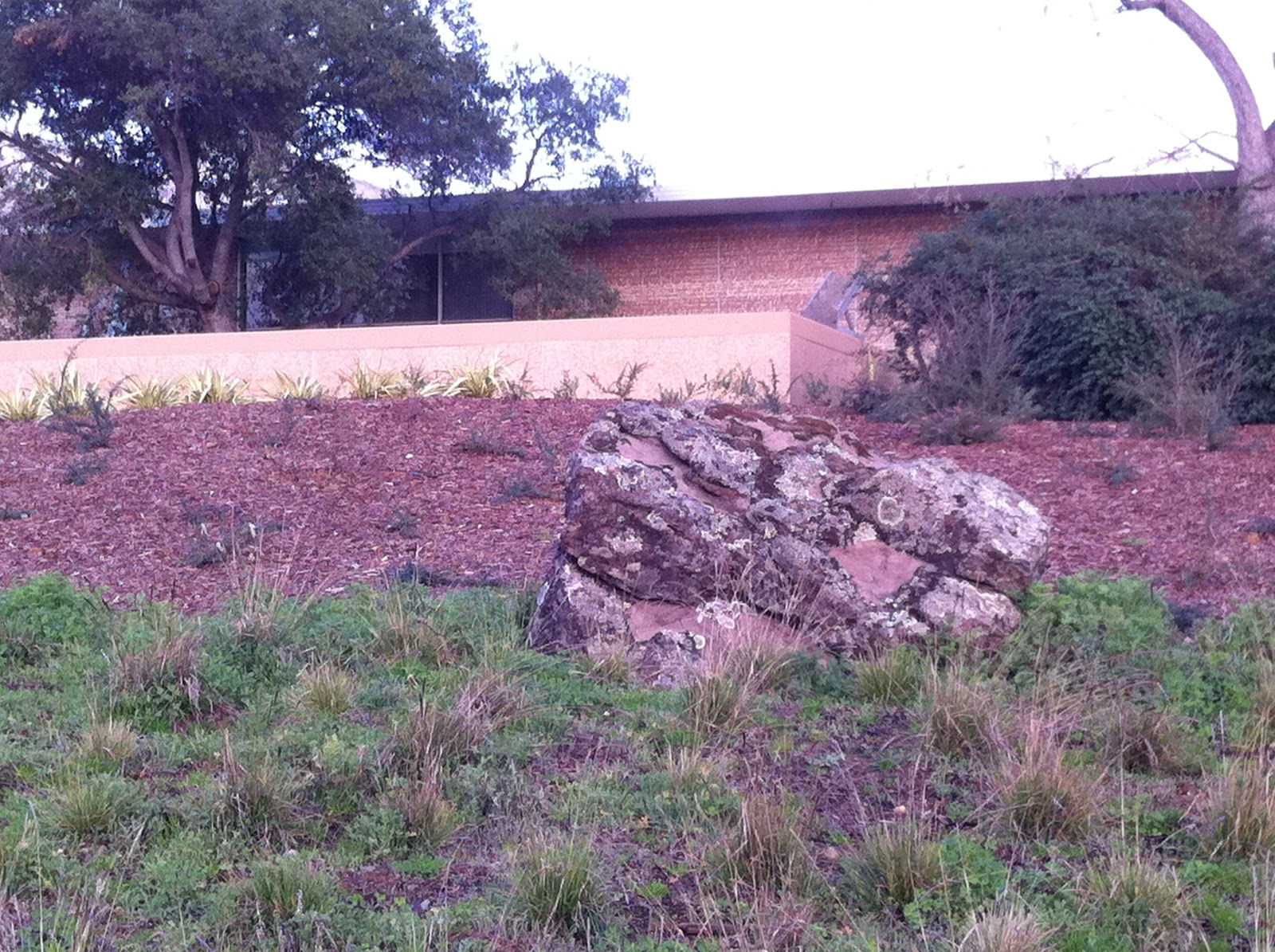
Rock out. Boulders in the landscape are timeless sentinels, a great way to define spaces and make any area feel more natural. They look their best when they seem to be emerging from the earth — I typically specify they be buried to about 1/3 of their height. And bigger is better, perhaps because it seems impossible that such mass could have been placed by man. I was thrilled to see these ginormous specimens going in at the Hewlett-Packard campus at 1501 Page Mill Road in Palo Alto. Too bad some of them didn't go in quite far enough. The groundcover plantings may yet grow up to hide the "taper" at the rocks' bases, so no awards here — yet. But I'm watching.


It's not all bad out there, though. A couple of winners deserve mention:


Acer freemanii 'Autumn Blaze'

Leucadendron species

Muhlenbergia filipes

Go into the light. Especially in the winter when the sun is low and weak, we have lots of opportunities to create stunning effects with plants that either reflect the light or refract it. Palo Alto has been putting in lots of Freeman maples lately, and their color is some of the most brilliant I've seen. Up in San Francisco, this set of Leucadendron from Flora Grubb Gardens positively glows in the late afternoons, as do the massings of Pennisetum and Muhlenbergia grasses at Solage resort in Calistoga. Awards all around for designing with a "light" touch.


How to get air and water to these roots?

Cut a pervious strip into the asphalt

Better still, cut in a lot!

Put down roots. It's not new this year, but I think I'll give my best in show award to the repaved parking lot at Town and Country Village, which has held up extremely well for a few years now. The best part? The permeable "slots" cut into the asphalt, set with interlocking pavers whose gravel-filled gaps allow air and water to reach the roots of the heritage Valley Oak trees that give the property so much character. It's an incredibly simple, yet creative, solution that I haven't seen anywhere else. I'll be "root"ing for its success.


When your eyes are open, it's remarkable how much you can learn from the big guys. Please let me know if you have any lessons to share. And thanks for giving me some of your time this year… here's to continuing our education in 2011!

Nov 15, 2010

Learning from the Big Guys, Pt. 5


Warms the soul, sparks the imagination.
Visiting places that have spent a great deal of money on their grounds is a perfect opportunity to see up close the best and the worst of landscape planning, and to continue learning from the big guys. 

At one very chic, eco-conscious and rustically contemporary (is that a style? it is now) Napa Valley resort lives this charming concrete fire pit. This hearth is the heart of the outdoor "foyer" at the spa area; it is in the middle of a pathway, with no seating around it, so I'm guessing its purpose is not so much for literally warming oneself as for symbolizing the inner warmth the spa services nurture and awaken. I have a minor quibble with this — lowercase 'q' — because frankly, I enjoy sitting around a fire, and can't do that here without perching somewhat awkwardly on the narrow edge of the wall. (A typical depth for a seatwall would be about eighteen inches, to fit most posteriors comfortably; this is about six inches deep.) On the other hand, this might be intentional, to subtly discourage über-relaxed and probably slightly tipsy guests from sitting too close to an open flame. 

What catches me more are a couple of aesthetic issues. I will grant up front that these may have been conscious choices; however, even if they were, I don't agree with them. First, in this clean and contemporary resort there are lots of straight lines, which the fire pit's square shape complements perfectly. The circular fire burner, however, has no precedent that I can see. Granted, the resort's logo is circular, but this is not carried into the architecture or landscape. What's more, the circle-within-a-square feels busy and disruptive, not calming, to me. A square burner would have been better, and more in keeping with the overall geometry of the place. Funny how such a little detail can have such a big effect.

Section view of a likely form
for the concrete fire pit.
Second, I noticed the horizontal seam about six inches above the pavement, about twelve inches below the top of the wall. This pit is solid concrete, which would have been poured into a "form" comprised of an inner wall and outer wall. Most likely, each wall was constructed of one 2x12 board stacked on top of another to achieve a height of about eighteen inches above the concrete pavement (as shown in my little sketch). The seam probably resulted where the concrete oozed between the boards, as very heavy sludge is wont to do.

Now, forming concrete is a talent I certainly do not possess. But the location of this seam annoys me. Could it have been a conscious design decision? There are other raised planters on the property with the same seam, but other than that I don't see any other precedent for dividing surfaces into 2/3 - 1/3 sections like this. And even if there were precedents, what does it mean? If it were an artistic statement, it should at least be intelligible. So I'm going to guess no, this wasn't an aesthetic choice. I'll guess it was a result of (a) going with the easiest solution to build; or (b) miscommunication between the landscape designer, who didn't specify how the forms should be built, and the builder, who didn't realize the aesthetic consequences of their methods.

One way to center the seam
If I were the designer, I like to think, I would have realized a seam would be inevitable (because there would need to be at least two rows of boards), and would have specified that the seam be centered on the wall. Yes, this probably would have meant using three rows of boards: a 2x12 top board ripped to be 9" tall (so the seam would be halfway down the 18" face), a 2x12 in the middle, and a 2x3 or 2x6 on the bottom.

This level of detail makes the construction much more complex in the short term. So does custom-fabricating a square burner. But in the long term — and we designers are paid for long-term, big-picture thinking — I think it would be worth it if no guest (not even a nit-picky designer) ever looked at this otherwise wonderful resort's fire pit or planters and thought, "Huh. That's weird."

Jul 8, 2010

Choosing the Right Designer for You

As my voicemail fills with eager requests for landscaping ideas before summer slips away, here's some wisdom from a few years back that bears re-posting.

I'm often asked what my style of design is. It's a bit of a pat answer to say "your style," but it's not far off.

After all, no landscape designer worth their soil is so inflexible they can't work with more than one kind of client or architecture. And a really good designer will be part researcher, part psychologist and part psychic as well, so that we know our client really well -- so well that we can deliver unique ideas and solutions that may be unexpected but are never unwelcome.

So how can you know whether a given landscape designer is a good fit for your property?
1. Don't pick an "English country" designer just because you have a Tudor-style home. In the first place, you'll be limiting your design options, perhaps unneccessarily. (See #2, below.) In the second place, a designer who specializes exclusively in one genre like this probably would offer you the same palette of plants and cookie-cutter look as their last customer. (The notable exception may be designers such as Indig Design who specialize in native plant communities... not an aesthetic style as much as an ecological one.)

2. Unless you give very clear-cut and detailed direction, don't put too much stock in the designer who, on first sight, knows "exactly how" they would design your garden. Intuition and vision are wonderful, and certainly first impressions last. But anyone who weds themselves to a single idea without doing a bit of reconaissance on your property and developing alternative designs is missing the details that will make your garden truly yours over the long term.

(2b. If you do have very clear-cut and detailed direction, you may want to simply hire a contractor and skip the design phase. You'll have more money to allocate to construction, and you'll be able to move forward with your project faster.)

3. Don't pick a designer just because theirs is the biggest ad in the phone book or at the top of the search engine ads. That's only an indicator of how much advertising they do; it tells you nothing about the process or quality of their work.

4. Do retain the designer that your friends, neighbors, or trusted associates are raving about. Even if their home looks nothing like yours, the raves probably are for how the designer handled the project -- process, fees, attention to detail, communication -- as much as for the finished look. Websites like Yelp can be helpful here as well.

5. Do retain the designer who asks about and understands your budget -- and agrees to work with you anyway. If you have $100,000 - $250,000 to spend on your landscaping, you'll want to make sure you interview designers who are accustomed to budgets (or properties) that size. On the other hand, if you have 1/10 that amount to spend, you'll want to talk with the designer who knows how to make $25,000 look like a million bucks.


6. Do retain the designer who "feels right" to you, regardless of budget or style. You'll be working closely with this person on myriad details, and s/he will need to interpret your wishes, dislikes and personality. If their references check out, if they have creative and practical ideas to offer while respecting your own, if they know their stuff and can communicate it clearly in pictures and/or words, and most importantly if you feel comfortable talking and exchanging ideas with them, that designer will probably be a joy to work with... and your new garden will be a joy to live in.

May 27, 2010

Know Thyself

© Cindy DyerA few weeks ago I had the privelege of being interviewed by one fantastic nature photographer, graphic designer and gardener, Cindy Dyer. The interview touches on some of the "day in the life" stuff that most of my clientele never get to see, and it's receiving some pretty favorable responses.

I'm honored that people enjoy learning about me and my work. The interview was a lot of fun for me, too, because it gave me a chance to reflect more deeply than usual on not only my work but also what inspires me. And a little self-knowledge is a powerful thing.

In the course I teach on Custom Garden Design, the first class is devoted to getting to know yourself better. After all, a garden can't be very personal if you don't know the person. But as I went through a couple of exercises designed to help identify my students' influences and inspirations, I could see eyes glazing over, as if they were terrified to get in touch with anything that might be meaningful for them. One gentleman spoke up: "This is supposed to be a course on garden design. We've been here an hour; are we going to do any garden design?"

I reminded him that the course was on custom garden design. As in, the garden you won't find in the pages of any book or magazine. The garden that fits you like a bespoke suit. If all he needed was to fill a corner of his yard, I offered, he could have spent his money at the local nursery instead of my class. But if he wanted that corner of the yard to be a place that feels like "home," that just seems right whenever he looks at it or sits in it, then he'd better get to know a bit about what makes him tick.

Now, I understand that I'm pretty open to introspection, self-awareness and all that Northern California touchy-feely stuff, maybe more so than a lot of people. But garden planning isn't deep therapy. It shouldn't be threatening or intimidating. Quite the contrary: developing your landscape wishlist should be pleasurable, a mini-vacation as you allow your mind to wander to the places and times that have been most enjoyable in your life. It's a chance to revisit the best parts of your life, and even to imagine places you've never been: I've never dipped a toe in the Caribbean, but I can practically feel the fine white sand under my feet, the gentle breeze cooling my sun-kissed face, the calm warm water caressing my legs. I can smell the coconut (OK, and the rum to go with it), and I can hear the clacking of palm fronds against each other and the warbling of some bird or other. I can tell you, without ever having been there, that the Caribbean would be an intensely relaxing place for me. And if I desire intense relaxation from my garden, I could try to recreate some of these sensory pleasures there.

In design-speak, we say this is part of the design program. The program includes a lot of other, quantitative stuff too: the size and shape of your property, the sun exposure, adjacent conditions such as trees and buildings, budget, timeline, and so on. But your wishlist is a necessary component, for it gives us a goal to strive for. Sure, we probably won't be building a beach in your backyard. But if we can understand what about that beach makes it pleasurable and meaningful to you, then we can be very strategic in our design, and probably create a pleasurable and meaningful environment without a gram of white sand.

I don't know whether my student will be able to dig that deeply within himself. Some of us can't. I do start my clientele off with a questionnaire to begin identifying their wishes and needs, and I also ask them to create (if they haven't already) an "idea file" with magazine clippings, photos, journal writings, whatever might give me that qualitative sense of their preferences and priorities. Even if they don't know what attracts them to a particular garden, I tell them, if I have enough data to work with, I can connect the dots and synthesize a design direction.

If you've ever tried one of those one-size-fits-all plant combinations from a book or magazine, chances are it hasn't lived up to your expectations. It's not your fault! You simply may have been starting at the end of the design process, instead of the beginning. Get to know yourself a bit better, and your garden will be the better for it.

May 4, 2010

Learning from the Big Guys, Pt. 4

(By the way, I had nothing whatsoever to do with this combination of 'St. Josephs Coat' rose, unspecified iris, and Cerastium tomentosum… I saw it last week in a Los Altos front yard, and it just makes me happy.)

I've written before about learning from the big guys, but sometimes we can learn from the little guys, too — particularly when they make mistakes that, although not big in an absolute sense, are relatively huge.

I met recently with a Palo Alto homebuilder of considerable repute, who had endured what he deemed a "terrible" experience with a garden designer who also is a licensed landscape contractor. Hoping to learn from her missteps, I pressed him on what had gone so wrong. It boiled down to essentially three sins:

One, she didn't take direction. "We would make changes to the plan," the builder said, "and the same things would show up in the next revision." To me, it sounded like a rookie mistake: confusing your own interests with the client's. I'm not saying the client's ideas are always right; but their interests are.

Two, the designer's ideas were weak. Perhaps she threw them together hastily, perhaps she went with her first thought instead of developing more concepts and challenging her own limits. Perhaps she wasn't paid enough to put adequate time toward concept development. I don't know. I wasn't there. But none of those is a good excuse for faulty logic or cookie-cutter designs.

Third, she overstepped her role. Assigned to develop a pathway, she reconfigured the front porch as well. (This upset the architect considerably.) Given a budget and scope of work by the builder, she "added value" with elements that were integral to the design yet unaffordable. As a contractor herself, the builder said, she should have been able to provide creative alternatives without losing sight of costs.

In fairness, I got only one side of the story. But it's a great cautionary tale regardless. Landscape designers are not fine artists, accountable only to ourselves; we are commercial artists, accountable to our clients (and often serving many clients with a single work). Our creativity is meaningless if we lose sight of its object. And while we're certainly entitled — obliged, even — to stand up for our ideas, we mustn't forget that we do not have to live with our own work.

Having a good idea isn't enough: we must have the right good idea.

Feb 8, 2010

Fast, Good and Cheap

In a previous life I worked at one of the best ad agencies in the Bay Area. It wasn't quite Mad Men, but we did have our Friday open bar, our eccentric namesake, and our brilliant but misunderstood creatives — who gave me some pearls of wisdom that resonate to this day.Perhaps the most impactful was a simple graphic on an art director's door: a triangle with the words "fast," "good" and "cheap" at its points, anchored by the admonition "Pick Two."

I've come across this concept a few times since, so I don't think it was Kathy's invention. But at the time, it hit me like a lightning bolt: Anything is possible, and everything has a price.

Landscape designers, architects and contractors confront this triangle a lot. Especially this time of year, when folks remember they wanted a new back yard for the kids to play in this summer. They call me, full of optimism and good ideas… and their disappointment is audible when they realize I can't start on their landscape design immediately, or that the consultations I can offer in the next few weeks (to get them off to a roaring start with a landscape contractor now) actually cost money.

Is the problem that we live in an age of instant gratification and commoditized services? The internet has made seemingly all things available to all people, and often for free: want a book tomorrow, without the inconvenience of driving to your local bookstore? Amazon does that. Want to try on shoes, without having to drive to the store or pay to receive or return them? Zappos has you covered.

But landscape designers and contractors aren't retailers. Our work isn't a commodity that can be comparison-shopped. Sure, the local gardener can advertise design services just as legitimately as I can (though there might be vast differences in our training), and probably get to your project a lot sooner. He probably costs a lot less, too. But would he and I give you the same artfulness in our designs, the same thorough process, the same attention to detail from beginning to end? "Fast and cheap" still carries a cost.

My neighbor, who is incredibly nice, smart, and well-intentioned, took it upon himself around Hallowe'en to rebuild his front irrigation system. I remember the skeleton bones he poked out of the trenches; great effect. But now, some three months later, he's just finishing the project (although still sans plants). Is his labor cheap? Definitely. Good? Probably. Fast? Not so much.

Fast & Cheap
(the graphics, not the ideas)
At different times, I'm different legs of the triangle. My clients will tell you I'm pretty good. And depending on the circumstances, I can be relatively cheap, or pretty fast (as those Landscape Smart episodes attest). I'm not immune to mistakes, especially when I try to cram too much work into too little time; that's when "good" gives way to "fast." The only way to reclaim "good" is to put in more hours, usually in the middle of the night, and there goes "cheap."

I've worked with all types of clients. Some are willing to sacrifice "good" in the name of "fast and cheap." They're the ones hiring unlicensed contractors who don't bond their projects or pay worker's comp insurance. These aren't my ideal clientele, because there's no assurance the project will turn out well, and no real recourse if it doesn't. My favorite clientele are the ones who choose "good", and realize that choice includes a tug-of-war between "cheap" and "fast."

I've built my business, and my reputation, on providing "good" (well, actually, "great"). So that leaves either "cheap" or "fast." I'm happy to be either. I just can't be both.

Nov 11, 2009

Landscaping Small Spaces, Part 5

As much as I love the possibilities afforded by designing larger estate landscapes (as in, trees! I actually get to spec trees!), small gardens hold a special place in my heart as well. Here's the last of five bite-size tips to make the most of bite-size spaces:

Dry out. Because small yards are often planted right up to the house, using water-thrifty vegetation is one way to ensure foundations stay dry. Check with your local water utility for a list of recommended native or low-water plants for your area. Downspouts often may be tied into main lines that collect water in detention basins elsewhere on the property; from there, the water can percolate back to the groundwater. A French or trench drain along the home's foundation may also be useful for picking up extra water. And while these drain inlets often are topped with gravel, recycled colored glass may also be used, and even lit from beneath for a dazzling effect.

There are plety of other ways to add big impact to a small space. What are some of your faves?

Nov 2, 2009

Landscaping Small Spaces, Part 4

As much as I love the possibilities afforded by designing larger estate landscapes (as in, trees! I actually get to spec trees!), small gardens hold a special place in my heart as well. Here's the fourth of five bite-size tips to make the most of bite-size spaces:

Get wet. A modest fountain can create a big impact in a small space, especially with interesting lighting. Vertical columns of basalt rock can be drilled to create a naturalistic water feature, or employ a classic or modern container for a more elegant effect. A product such as the Aqua Box makes installation easier than ever. One or more translucent plastic tubes can be installed on end to create subtle waterfall effects, and metal salvage yards can also be a source of interesting fountain elements, from corrugated metal to stainless steel troughs that can spill into a basin below grade.

Next, I'll write about my fifth and final tip for landscaping small spaces: Dry out.

Oct 27, 2009

Landscaping Small Spaces, Part 3

As much as I love the possibilities afforded by designing larger estate landscapes (as in, trees! I actually get to spec trees!), small gardens hold a special place in my heart as well. Here's the third of five bite-size tips to make the most of bite-size spaces:

Think big. Small spaces get cluttered quickly, so resist the temptation to landscape on a petite scale. Instead, make a statement with a chunky, oversized pergola; boulders large enough to sit on; or a dramatic container that takes command of the space. Mirrors (or polished steel plates) can be used to reflect light and enlarge views; and large gates or doors, either freestanding or mounted on fences or walls, create the illusion of additional space beyond. Limit your planting palette to just a handful of species; it's far more effective to use a dozen each of three different plants, than three each of a dozen species. And if there's not enough space for all the full-size dining chairs you'd like, consider framing the dining area with a wood bench that will both define the room and provide additional seating when it's needed.

Next, I'll write about my fourth tip for landscaping small spaces: Get wet.

Oct 21, 2009

Landscaping Small Spaces, Part 2

As much as I love the possibilities afforded by designing larger estate landscapes (as in, trees! I actually get to spec trees!), small gardens hold a special place in my heart as well. Here's the second of five bite-size tips to make the most of bite-size spaces:

Be colorful. Knowing that bright colors seem to advance toward us, and dark colors seem to recede, create depth and dimension in small spaces by choosing appropriate hues. Use dark paving on patio floors. Stain perimeter fences dark brown or olive green, or cover them with dark green vines such as Hardenbergia 'Happy Wanderer'. Fill the foreground with variegated or chartreuse foliage, including Heuchera 'Key Lime Pie' and Hakonechloa macra 'Aureola' or 'All Gold'. Then bridge the front and rear spaces with textures, not colors — grasses or succulents look great en masse, with a specimen pot, fountain or statue as a focal point.

Next, I'll write about my third tip for landscaping small spaces: Think big.

Oct 12, 2009

Landscaping Small Spaces, Part 1

As much as I love the possibilities afforded by designing larger estate landscapes (as in, trees! I actually get to spec trees!), small gardens hold a special place in my heart as well. Here's the first of five bite-size tips to make the most of bite-size spaces:

Go vertical. A small space quickly draws the eye to its perimeter. Interrupt that line of sight and create a three-dimensional yard with
vertical elements including tall, narrow plants (such as bamboo, crepe myrtle or 'Whitespire' birch trees); raised planting beds or berms; or freestanding trellis structures. Be sure to include accent lighting to show off these features at night. In the other direction, excavating a sunken garden can pose construction challenges, but the results can be spectacular. Retain and frame the area with a stone seatwall; include niches in the wall for candles or planter urns (including self-watering styles) and seat cushions with delicious custom fabrics.

Next, I'll write about my second tip for landscaping small spaces: Be colorful.

Aug 21, 2009

Futzing With The Recipe

Image courtesy GroovyVegetarian.comI've been watching more Food Network lately than usual, which can only mean that autumn is around the corner.

What I like about Food Network is that it makes food — or, more precisely, an elevated dining experience — approachable. I'm no gourmet chef, but I can still up my cooking game thanks to Bobby, Rachel, Giada, Alton et al.

However, such egalitarianism carries a risk: once I feel empowered to cook North African Meatballs, I also feel empowered to change the recipe. Perhaps I leave out the cilantro, or add a bit of nutmeg. Perhaps, when I'm making Ina's French toast, I use nonfat milk rather than half & half. Or maybe I only have medium eggs on hand, not extra-large.

Whatever, right? After all, some of the joy of cooking is experimenting, putting your own stamp on things. Except, too often I take that first bite and think, "Hm. This looked a lot better on TV." I then shelve the recipe and forget about it — never really getting that it's my fault the French toast fell flat. Somewhere along the way, I forgot: I'm no gourmet chef.

Gardening isn't terribly different from cooking. How often do we drool over the plants we see at the nursery or in the magazines, and decide to experiment with them in our own yard? Never mind that our site has deeper shade, or gophers, or a careless gardener. Never mind that winter brings temps in the 20s and that plant isn't hardy below 35°F.

Sometimes the experiment turns out great. Experienced gardeners are like experienced chefs: they know their ingredients. They know their site, the way a chef knows her oven. And they know the rules (even if that means knowing which rules to break).

But for less experienced gardeners, the experiment might not be quite as rewarding. Plants bought impulsively die; favorite trees sulk wedged into too-small spaces; and those combinations that "should" have worked, well, they looked a lot better on TV. Discouraged, we vow to never again spend our weekend in the garden.

I'm not at all suggesting we shouldn't experiment with our gardens. It's not only likely we'll make mistakes, I believe it's vital. But if you're going to take risks, take responsibility too. Know that the plant combination featured in this issue of Fine Gardening isn't well-suited to your clay soil. Know that there's a difference between a Spiraea and a Nandina, and therefore probably a good reason your landscape designer specified one rather than the other. Know that "regular irrigation" isn't synonymous with "drought tolerant."

If you're not interested in such minutiae, your best bet probably is to hire a pro to design for you. Think of it as going out to a really nice restaurant: sure, you'll pay more, but the experience will be wonderful, and you won't dirty a dish.

On the other hand, if you really yearn to be out in the garden, why not hire a landscape designer, fine gardener or garden coach to help you learn? You can be the sous chef, or at least the apprentice. You may still lose a few plants and blow through some money along the way. But when you do come up with your own amazing creation, you'll be able to take all the credit.

Aug 6, 2009

Learning from the Big Guys, Pt. 3

In the previous installment of this series, I wrote about spacing plants appropriately (or not). Courtesy of my commercial neighbors in Palo Alto, here's an example with a smaller species, where tight spacing feels entirely appropriate. River birch in the landscapeBetula nigra, or river birch, is one of my favorite trees — its exfoliating cinnamon bark is visually arresting, and its canopy provides delightful dappled shade. In this cluster, the trees within each trio are planted about 14 feet on center, and the trios are about 19 feet apart. This grove would be a wonderful spot for a bench, fountain, or other lingering point. The biggest downside would be the tree roots: birches are notorious for surface rooting, which can heave a flagstone patio or invade a lawn. Placing a feature inside this grove would be a short-term proposition; and planting these trees close to a hard edge could compromise the hardscaping.

This brings me to another point: when reference books talk about surface rooting — or any characteristic, for that matter — they're not just using up ink. No matter how good your intentions, you will not be the exception to the printed rule. Fraxinus roots invade lawnFor instance, if a tree is reported susceptible to verticillium wilt, and your soil has verticillium fungus, that's not a good tree for you. If a tree is said to grow 40 feet wide, you'll have a hard time keeping it at 20. And if a tree is said to root close to the surface, that's not a good choice next to a lawn, or next to hardscaping. Here's a Fraxinus (ash) that quite owns the lawn around it. It's a big tree, not a bad choice for screening the parking lot from the building, but definitely incompatible with turf. Can you imagine trying to mow around this without scalping the roots? If you were the maintenance crew, wouldn't you stop trying?

So, given that Fraxinus roots do this, would you use the same species as a street tree in a 4' wide planting strip? Fraxinus as a street tree Perhaps it'll be fine, since the roots surface in an effort to find water and the sidewalk offers none. Me, I wouldn't take the chance. And given that this is in Palo Alto, whose choice of Liquidambar as street trees I curse every autumn (usually after twisting an ankle on one of the ubiquitous seedpods), I don't have high expectations.

But I'll keep watch… and learn from the big guys.

Jul 27, 2009

Faith, Hope…

    The Jesusita Fire raged for days through Santa Barbara, California and continued to burn until the Santa Barbara County Fire Department declared the fire to be officially under control on May 22, 2009. In its wake, the fire burned over 8,700 acres of land and destroyed 80 homes.  — Santa Barbara Botanic Garden


On my recent vacation we passed through Santa Barbara and stopped by the fabulous SBBG, which had taken a big hit from the Jesusita Fire. Just up the road, a pile of twisted metal and black and gray rubble bore witness to the fire's devastation. On May 5, that was someone's home. On May 7, it wasn't.

Over on the other side of Mission Canyon, beautiful homes stood untouched, a testament to the latest heroism of thousands of firefighters. A couple of years ago, a Cal Fire captain in San Mateo told me that crews will focus their efforts on homes they know they can save, rather than spend precious time and resources on potentially losing battles. It was a harsh wake-up call: if your home isn't accessible or easily defensible, it's as good as gone.

Our mood was somber as we surveyed the scene. But then I noticed something odd: These charred sticks that used to be trees, they were sprouting. Growing. Regrowing. They were alive, and nothing as petty as an 8700-acre inferno was going to change that.

I was filled with hope. This is why we garden: to witness the unpredictable, play some part in the impossible. We plant a Salvia and hummingbirds materialize out of thin air. We plant the smallest of seeds and watch tiny leaves emerge after the coldest winters. We plant a tree, knowing we won't get to relax in its shade but that our children's children might. I'm sure I'm not the first to say it, but landscaping is an act of faith, a confidence that things will be all right — even if we can't know when or how.

A few weeks before our trip, the contractor remodeling the home next to ours had invited me to redesign its front yard. We both were delighted with my combinations of Phormium 'Dusky Chief', Euphorbia 'Helena's Blush', Nandina 'Gulf Stream', Festuca ovina glauca, Lavandula 'Provence' and Heuchera x 'Caramel'.

During our time away the weather had been hot, very hot, and as we rolled up to our driveway I wasn't surprised to see a few of my container plants had died. But the real shock was the house next door. My beautiful, drought-tolerant creation was… gone. All gone. Replaced by no less than the gratuitous lawn I despise. Explanation? The homeowner got cold feet, wanted "ordinary." Apparently extraordinary was too good.

I was devastated. I'm still upset. But I think of the people who lived in the house that is no more, and I realize that there are worse things than a garden gone wrong. And I think of those blackened twigs sending up their bright green leaves, and I realize that Nature has a way of righting herself.

All we have to do is keep the faith.