Showing posts with label inspirations. Show all posts

Jun 18, 2011

Learning from the Big Guys, Pt. 7

It's been an incredibly busy year so far, leaving me with lots of thoughts swirling around in my head but precious little time to put them in writing. But my daily travels take me past a few examples of poor landscape planning, and I'm never too busy to learn from the big guys. Today we examine some examples of what happens when the age-old rule "right plant, right place" is broken.

It's a great idea to plant tall trees on the south and west sides of a building. They help shade the structure and reduce heating costs, especially in a sun-drenched climate like Palo Alto. It's also a great idea to use native species such as the coast redwood, Sequoia sempervirens. What's not such a great idea is planting a tree that wants to be 100 feet tall beneath eaves that are 40 feet high. Something has to give here, and I'm betting it won't be the building. Anyone want to make odds on how many days before this poorly-planned tree is removed?


 The Palo Alto JCC is a wonderful example of modern urban infill. It's got intimate courtyards and simple but effective stands of plantings that make it a great space for people. Unfortunately, the designers consistently underestimated the demands of the Center's vehicular traffic, specifically the turning radii cars and trucks would need. Perhaps the planners were simply optimistic that the center would attract fuel-efficient small cars rather than large trucks or SUVs; however, even the average minivan (of which the family-oriented Center attracts plenty) is challenged by turns that are too sharp and lanes that are too narrow. As a result, a couple of walls in the parking garage have been damaged by car bumpers, and curbs have had to be cut or removed and reconfigured. Orange safety cones are proliferating, and overall the traffic areas are looking like a patchwork of temporary fixes — except they're not temporary.

Outside, the entry driveway circles around a center median that is not contained by a raised curb. On the one hand, this is useful because it allows the median to receive stormwater from the surrounding pavement, an effective environmental strategy (the Center earned LEED Silver certification). On the other hand, the absence of a curb means that vehicles can — and do — cut the turn and drive through the planter. This means more orange cones, and a chronically muddy mess that always seems to hold standing water. It's too compacted to sustain plants, and they'd probably get driven over anyhow. The lesson here? Turns require far larger radii than we may think: at least 15-20' inside radius for a passenger car, more for service vehicles such as delivery trucks, and a correspondingly large outside radius so the front outside corner of the vehicle's bumper can sweep through the turn without hitting tangential walls or parked cars or people. If you've absolutely got to have a tight turn without a curb, at least don't put plants inside the curve — use paving stones or some other material that can take the abuse.


Speaking of cars and people, it's always useful to remember that people get into and out of vehicles, and enjoy a bit of clear space in which to do so. This isn't exactly a "big guy," but it is a useful reminder that heavily armed plants such as Agaves — as well as spiny Berberis, Pyracantha and roses, and even sharp-foliaged plants such as Mahonia and Picea (spruce) — make great barriers but usually aren't great selections for a space where people or pets will be passing close by. On the other hand, though, I'd wager this tree hasn't suffered a door ding or the indignity of dog pee in years, so maybe this planting strategy is genius after all — "right plant, right place" doesn't always mean what we think. 


Dec 31, 2010

Learning from the Big Guys, End-Of-Year Edition

Some of my best landscape design inspirations come from simply walking around in the world. It's also a fantastic education, and you can't beat the price. Here are a few of the lessons I've learned this year — for worse and for better.


The good: at NapaStyle, Yountville
The bad: Carlsbad office park
The just plain stupid: San Mateo mall

Handle your water. Water in the landscape can be a wonderful element to either enliven or calm a space. Unfortunately, from poorly designed irrigation that applies more water to the pavement than the lawn, to poorly conceived drainage that creates safety hazards, there's no shortage of examples of ways we all can handle our water better. My "Worst of the Wettest" award goes to the fountain at an outdoor shopping center in San Mateo. The open, parklike setting is so sunny, so warm, so lush, so… so stupid to create a ramp right up to the water's sparkling edge, then post a "No Water Contact Allowed" sign.


I just hope the tequila was worth it

This used to be a Black Oak

Why bother?
Hedgehogs on parade


Make the right cut. When you put plants in a landscape you're entering into a bit of a contract. They'll provide shade and process carbon dioxide, and you'll give them food, water and a bit of tender loving care every now and then. Unfortunately, too many gardeners — homeowners and municipal landscapers alike — forget the "tender loving care" part, and we wind up with pruning abominations like these. My "Cruelest Cut" award goes to whomever decided California Gray Rush should be pruned into little hedgehogs every winter. (Hint: it's not actually a grass. Let it grow.) It's not fair to the plants, and it's not fair to those of us who have to look at them.


Sculpture at building entry in SF

At UCSF Mission Bay, paving acts as carpet

Look up! No, up!


Where's the magnifying glass?

Lead the way. An entire industry has evolved around "wayfinding" — the art of helping people navigate through complex environments, particularly in urban settings. Personally, I really enjoy when this can be achieved implicitly, with landmarks such as sculpture or variations in paving materials rather than explicit signs. Sometimes, though, signs simply are the best medium for communicating what lives where. But they're pretty useless if they're so tall, and the lettering so small, as to be unreadable. My "Losing Sight of the Destination" award goes to the City of Palo Alto, which installed such signs at major intersections along University and California avenues. Good thing no one goes there anymore.


Emerging from the earth…

… vs. dropped from the sky.

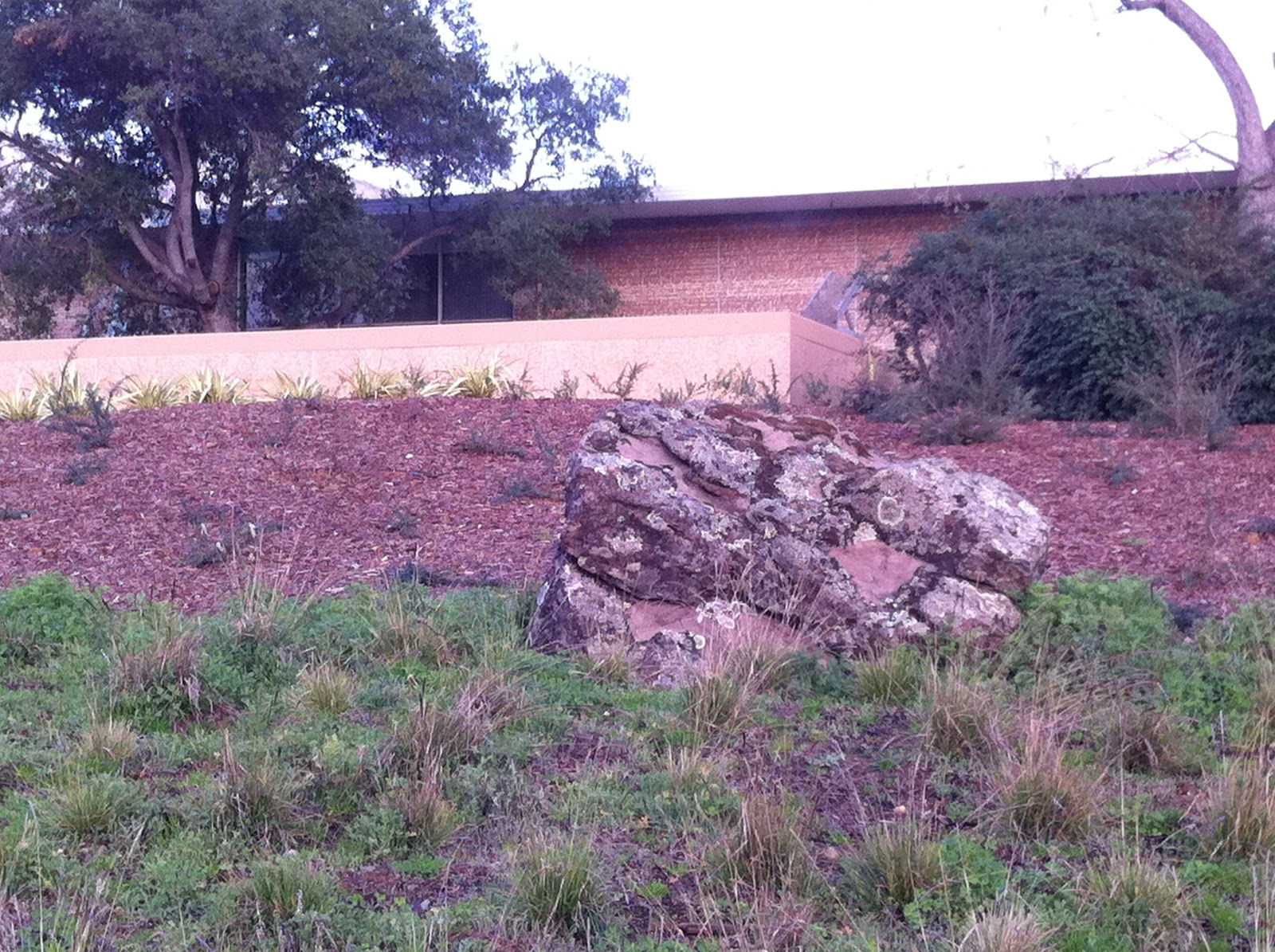
Rock out. Boulders in the landscape are timeless sentinels, a great way to define spaces and make any area feel more natural. They look their best when they seem to be emerging from the earth — I typically specify they be buried to about 1/3 of their height. And bigger is better, perhaps because it seems impossible that such mass could have been placed by man. I was thrilled to see these ginormous specimens going in at the Hewlett-Packard campus at 1501 Page Mill Road in Palo Alto. Too bad some of them didn't go in quite far enough. The groundcover plantings may yet grow up to hide the "taper" at the rocks' bases, so no awards here — yet. But I'm watching.


It's not all bad out there, though. A couple of winners deserve mention:


Acer freemanii 'Autumn Blaze'

Leucadendron species

Muhlenbergia filipes

Go into the light. Especially in the winter when the sun is low and weak, we have lots of opportunities to create stunning effects with plants that either reflect the light or refract it. Palo Alto has been putting in lots of Freeman maples lately, and their color is some of the most brilliant I've seen. Up in San Francisco, this set of Leucadendron from Flora Grubb Gardens positively glows in the late afternoons, as do the massings of Pennisetum and Muhlenbergia grasses at Solage resort in Calistoga. Awards all around for designing with a "light" touch.


How to get air and water to these roots?

Cut a pervious strip into the asphalt

Better still, cut in a lot!

Put down roots. It's not new this year, but I think I'll give my best in show award to the repaved parking lot at Town and Country Village, which has held up extremely well for a few years now. The best part? The permeable "slots" cut into the asphalt, set with interlocking pavers whose gravel-filled gaps allow air and water to reach the roots of the heritage Valley Oak trees that give the property so much character. It's an incredibly simple, yet creative, solution that I haven't seen anywhere else. I'll be "root"ing for its success.


When your eyes are open, it's remarkable how much you can learn from the big guys. Please let me know if you have any lessons to share. And thanks for giving me some of your time this year… here's to continuing our education in 2011!

Nov 15, 2010

Learning from the Big Guys, Pt. 5


Warms the soul, sparks the imagination.
Visiting places that have spent a great deal of money on their grounds is a perfect opportunity to see up close the best and the worst of landscape planning, and to continue learning from the big guys. 

At one very chic, eco-conscious and rustically contemporary (is that a style? it is now) Napa Valley resort lives this charming concrete fire pit. This hearth is the heart of the outdoor "foyer" at the spa area; it is in the middle of a pathway, with no seating around it, so I'm guessing its purpose is not so much for literally warming oneself as for symbolizing the inner warmth the spa services nurture and awaken. I have a minor quibble with this — lowercase 'q' — because frankly, I enjoy sitting around a fire, and can't do that here without perching somewhat awkwardly on the narrow edge of the wall. (A typical depth for a seatwall would be about eighteen inches, to fit most posteriors comfortably; this is about six inches deep.) On the other hand, this might be intentional, to subtly discourage über-relaxed and probably slightly tipsy guests from sitting too close to an open flame. 

What catches me more are a couple of aesthetic issues. I will grant up front that these may have been conscious choices; however, even if they were, I don't agree with them. First, in this clean and contemporary resort there are lots of straight lines, which the fire pit's square shape complements perfectly. The circular fire burner, however, has no precedent that I can see. Granted, the resort's logo is circular, but this is not carried into the architecture or landscape. What's more, the circle-within-a-square feels busy and disruptive, not calming, to me. A square burner would have been better, and more in keeping with the overall geometry of the place. Funny how such a little detail can have such a big effect.

Section view of a likely form
for the concrete fire pit.
Second, I noticed the horizontal seam about six inches above the pavement, about twelve inches below the top of the wall. This pit is solid concrete, which would have been poured into a "form" comprised of an inner wall and outer wall. Most likely, each wall was constructed of one 2x12 board stacked on top of another to achieve a height of about eighteen inches above the concrete pavement (as shown in my little sketch). The seam probably resulted where the concrete oozed between the boards, as very heavy sludge is wont to do.

Now, forming concrete is a talent I certainly do not possess. But the location of this seam annoys me. Could it have been a conscious design decision? There are other raised planters on the property with the same seam, but other than that I don't see any other precedent for dividing surfaces into 2/3 - 1/3 sections like this. And even if there were precedents, what does it mean? If it were an artistic statement, it should at least be intelligible. So I'm going to guess no, this wasn't an aesthetic choice. I'll guess it was a result of (a) going with the easiest solution to build; or (b) miscommunication between the landscape designer, who didn't specify how the forms should be built, and the builder, who didn't realize the aesthetic consequences of their methods.

One way to center the seam
If I were the designer, I like to think, I would have realized a seam would be inevitable (because there would need to be at least two rows of boards), and would have specified that the seam be centered on the wall. Yes, this probably would have meant using three rows of boards: a 2x12 top board ripped to be 9" tall (so the seam would be halfway down the 18" face), a 2x12 in the middle, and a 2x3 or 2x6 on the bottom.

This level of detail makes the construction much more complex in the short term. So does custom-fabricating a square burner. But in the long term — and we designers are paid for long-term, big-picture thinking — I think it would be worth it if no guest (not even a nit-picky designer) ever looked at this otherwise wonderful resort's fire pit or planters and thought, "Huh. That's weird."

May 27, 2010

Know Thyself

© Cindy DyerA few weeks ago I had the privelege of being interviewed by one fantastic nature photographer, graphic designer and gardener, Cindy Dyer. The interview touches on some of the "day in the life" stuff that most of my clientele never get to see, and it's receiving some pretty favorable responses.

I'm honored that people enjoy learning about me and my work. The interview was a lot of fun for me, too, because it gave me a chance to reflect more deeply than usual on not only my work but also what inspires me. And a little self-knowledge is a powerful thing.

In the course I teach on Custom Garden Design, the first class is devoted to getting to know yourself better. After all, a garden can't be very personal if you don't know the person. But as I went through a couple of exercises designed to help identify my students' influences and inspirations, I could see eyes glazing over, as if they were terrified to get in touch with anything that might be meaningful for them. One gentleman spoke up: "This is supposed to be a course on garden design. We've been here an hour; are we going to do any garden design?"

I reminded him that the course was on custom garden design. As in, the garden you won't find in the pages of any book or magazine. The garden that fits you like a bespoke suit. If all he needed was to fill a corner of his yard, I offered, he could have spent his money at the local nursery instead of my class. But if he wanted that corner of the yard to be a place that feels like "home," that just seems right whenever he looks at it or sits in it, then he'd better get to know a bit about what makes him tick.

Now, I understand that I'm pretty open to introspection, self-awareness and all that Northern California touchy-feely stuff, maybe more so than a lot of people. But garden planning isn't deep therapy. It shouldn't be threatening or intimidating. Quite the contrary: developing your landscape wishlist should be pleasurable, a mini-vacation as you allow your mind to wander to the places and times that have been most enjoyable in your life. It's a chance to revisit the best parts of your life, and even to imagine places you've never been: I've never dipped a toe in the Caribbean, but I can practically feel the fine white sand under my feet, the gentle breeze cooling my sun-kissed face, the calm warm water caressing my legs. I can smell the coconut (OK, and the rum to go with it), and I can hear the clacking of palm fronds against each other and the warbling of some bird or other. I can tell you, without ever having been there, that the Caribbean would be an intensely relaxing place for me. And if I desire intense relaxation from my garden, I could try to recreate some of these sensory pleasures there.

In design-speak, we say this is part of the design program. The program includes a lot of other, quantitative stuff too: the size and shape of your property, the sun exposure, adjacent conditions such as trees and buildings, budget, timeline, and so on. But your wishlist is a necessary component, for it gives us a goal to strive for. Sure, we probably won't be building a beach in your backyard. But if we can understand what about that beach makes it pleasurable and meaningful to you, then we can be very strategic in our design, and probably create a pleasurable and meaningful environment without a gram of white sand.

I don't know whether my student will be able to dig that deeply within himself. Some of us can't. I do start my clientele off with a questionnaire to begin identifying their wishes and needs, and I also ask them to create (if they haven't already) an "idea file" with magazine clippings, photos, journal writings, whatever might give me that qualitative sense of their preferences and priorities. Even if they don't know what attracts them to a particular garden, I tell them, if I have enough data to work with, I can connect the dots and synthesize a design direction.

If you've ever tried one of those one-size-fits-all plant combinations from a book or magazine, chances are it hasn't lived up to your expectations. It's not your fault! You simply may have been starting at the end of the design process, instead of the beginning. Get to know yourself a bit better, and your garden will be the better for it.

May 4, 2010

Learning from the Big Guys, Pt. 4

(By the way, I had nothing whatsoever to do with this combination of 'St. Josephs Coat' rose, unspecified iris, and Cerastium tomentosum… I saw it last week in a Los Altos front yard, and it just makes me happy.)

I've written before about learning from the big guys, but sometimes we can learn from the little guys, too — particularly when they make mistakes that, although not big in an absolute sense, are relatively huge.

I met recently with a Palo Alto homebuilder of considerable repute, who had endured what he deemed a "terrible" experience with a garden designer who also is a licensed landscape contractor. Hoping to learn from her missteps, I pressed him on what had gone so wrong. It boiled down to essentially three sins:

One, she didn't take direction. "We would make changes to the plan," the builder said, "and the same things would show up in the next revision." To me, it sounded like a rookie mistake: confusing your own interests with the client's. I'm not saying the client's ideas are always right; but their interests are.

Two, the designer's ideas were weak. Perhaps she threw them together hastily, perhaps she went with her first thought instead of developing more concepts and challenging her own limits. Perhaps she wasn't paid enough to put adequate time toward concept development. I don't know. I wasn't there. But none of those is a good excuse for faulty logic or cookie-cutter designs.

Third, she overstepped her role. Assigned to develop a pathway, she reconfigured the front porch as well. (This upset the architect considerably.) Given a budget and scope of work by the builder, she "added value" with elements that were integral to the design yet unaffordable. As a contractor herself, the builder said, she should have been able to provide creative alternatives without losing sight of costs.

In fairness, I got only one side of the story. But it's a great cautionary tale regardless. Landscape designers are not fine artists, accountable only to ourselves; we are commercial artists, accountable to our clients (and often serving many clients with a single work). Our creativity is meaningless if we lose sight of its object. And while we're certainly entitled — obliged, even — to stand up for our ideas, we mustn't forget that we do not have to live with our own work.

Having a good idea isn't enough: we must have the right good idea.

Feb 8, 2010

Fast, Good and Cheap

In a previous life I worked at one of the best ad agencies in the Bay Area. It wasn't quite Mad Men, but we did have our Friday open bar, our eccentric namesake, and our brilliant but misunderstood creatives — who gave me some pearls of wisdom that resonate to this day.Perhaps the most impactful was a simple graphic on an art director's door: a triangle with the words "fast," "good" and "cheap" at its points, anchored by the admonition "Pick Two."

I've come across this concept a few times since, so I don't think it was Kathy's invention. But at the time, it hit me like a lightning bolt: Anything is possible, and everything has a price.

Landscape designers, architects and contractors confront this triangle a lot. Especially this time of year, when folks remember they wanted a new back yard for the kids to play in this summer. They call me, full of optimism and good ideas… and their disappointment is audible when they realize I can't start on their landscape design immediately, or that the consultations I can offer in the next few weeks (to get them off to a roaring start with a landscape contractor now) actually cost money.

Is the problem that we live in an age of instant gratification and commoditized services? The internet has made seemingly all things available to all people, and often for free: want a book tomorrow, without the inconvenience of driving to your local bookstore? Amazon does that. Want to try on shoes, without having to drive to the store or pay to receive or return them? Zappos has you covered.

But landscape designers and contractors aren't retailers. Our work isn't a commodity that can be comparison-shopped. Sure, the local gardener can advertise design services just as legitimately as I can (though there might be vast differences in our training), and probably get to your project a lot sooner. He probably costs a lot less, too. But would he and I give you the same artfulness in our designs, the same thorough process, the same attention to detail from beginning to end? "Fast and cheap" still carries a cost.

My neighbor, who is incredibly nice, smart, and well-intentioned, took it upon himself around Hallowe'en to rebuild his front irrigation system. I remember the skeleton bones he poked out of the trenches; great effect. But now, some three months later, he's just finishing the project (although still sans plants). Is his labor cheap? Definitely. Good? Probably. Fast? Not so much.

Fast & Cheap
(the graphics, not the ideas)
At different times, I'm different legs of the triangle. My clients will tell you I'm pretty good. And depending on the circumstances, I can be relatively cheap, or pretty fast (as those Landscape Smart episodes attest). I'm not immune to mistakes, especially when I try to cram too much work into too little time; that's when "good" gives way to "fast." The only way to reclaim "good" is to put in more hours, usually in the middle of the night, and there goes "cheap."

I've worked with all types of clients. Some are willing to sacrifice "good" in the name of "fast and cheap." They're the ones hiring unlicensed contractors who don't bond their projects or pay worker's comp insurance. These aren't my ideal clientele, because there's no assurance the project will turn out well, and no real recourse if it doesn't. My favorite clientele are the ones who choose "good", and realize that choice includes a tug-of-war between "cheap" and "fast."

I've built my business, and my reputation, on providing "good" (well, actually, "great"). So that leaves either "cheap" or "fast." I'm happy to be either. I just can't be both.

Sep 3, 2009

The Biggest Little Farm in Napa

You've probably heard of The French Laundry, chef Thomas Keller's definitive nouveau American restaurant that launched a little Napa County town called Yountville into the culinary stratosphere. You may even know that The French Laundry grows their own produce, mostly in a two-acre plot across Washington Street that brims with herbs and seasonal vegetables—from broccoli and Brussels sprouts to beans, tomatoes, radishes, leeks, and a seemingly infinite number of lettuces, to name just a few.

But what you probably don't know is that when Chef Keller needs green almonds, or white strawberries, or one of 10 types of figs or countless different culinary flowers, he travels a little farther afield: to Jacobsen Orchards.

Although it's just a few blocks from The French Laundry, you won't find Jacobsen Orchards on any map, nor is it open to the public. As essentially the restaurant's R&D laboratory, the 1.3-acre farm teems with 120 fruit trees, half a dozen varieties of melon, 18 different citrus, 40 varieties of heirloom tomatoes, and curiosities most of us will never grow: white carrots, white miniature cucumbers, Japanese eggplant, caperberry, the odd-looking but delicious perennial tuber crosnes ("crones"), and the singular savory-acid-crunchy-juicy Ficoide glaciale.

Our host at Jacobsen Orchards was Ryan Hill, proprietor of the Hill Family Estate winery which has long ties to the land and landowner, Peter Jacobsen (aka PJ). Ryan walks the farm as if he had sown the seeds himself, bestowing samples of Korean mint and scarlet runner bean blossoms as he fluently discusses the breba crop of Brown Turkey figs. Ryan HillHe shows off the outdoor kitchen and fireplace, expertly crafted of rammed earth. And he gets our mouths watering with a description of "PJ's Peach Flambé," a dessert that sounds as much art form as recipe (below).

Nothing on the farm is wasted; or rather, every opportunity is maximized. The 'Sylvetta' arugula which has bolted? Its flowers are used in salads. The lovage which invites pollinator insects to the garden? Its pungent celery scent makes a great substitute for bay leaf. Long after those Brown Turkey figs are gone, the tree's leaves may be used to impart a coconut essence to soups and other dishes. Fennel pollen seasons fish, daylily petals are roasted into chips, garlic blossoms and lemon verbena leaves perform their olfactory sleights of hand. We and our host revel in the symbiotic relationship between the produce and the chefs who use it in their daily culinary alchemy.

CompostNaturally, all the green waste is composted, with the yield used as a mulch and reintegrated into the soil as crops are rotated throughout the seasons and years. The scraps also contribute to perhaps the farm's most precious product: snails, in fact the only certified organic culinary snails in the United States. The little critters are sourced to The French Laundry for—what else?—escargots, perhaps prepared into a fricassée with a puree of sweet carrots and roasted shallots. To accompany such a dish, Ryan recommends either the Hill Family's 2007 "Stewart Ranch" Pinot Noir, with enough acidity to complement the snails, or the silky-smooth tannins of their 2006 "Clarke Vineyard" Syrah. Happily for us, their tasting room also sells seed packets of some of Jacobsen Orchards' organic flowers and produce, so we can attempt to replicate a bit of the Jacobsen family's magic.

In the 15 or so years of its existence, I've never had the pleasure of dining at The French Laundry. If you have, most likely you've enjoyed the fruits of PJ's labors. But even if you haven't, chances are that almost any contemporary meal you enjoy has been influenced by Chef Keller. And, in turn, by Jacobsen Orchards.


***************

PJ's Peach Flambé
As narrated by Ryan Hill and Peter Jacobsen

"This is culinary theatre, a circus act that creates a great dessert. This is not a recipe for wimps."

Serves Four

Ingredients:
≤3 large peaches or nectarines, cut into irregular pieces
2 figs (not necessary, but adds flavor)
1/3 cup sugar
2 tablespoons butter
½ cup rum
½ cup Grand Marnier (or any orange based liquor)
Pint or quart (depends on how much your guests enjoy ice cream) Haagen Dazs Dulce de Leche

1. Sprinkle the sugar evenly over the bottom of a 12" frying pan and put it over very high heat. Let it melt until clear and then let the edges start to brown. You are creating caramels. Caution! The pan will be very hot.

2. Once the sugar has melted and you have the browned the edges (brown, not black) then add the butter. Don’t forget, the pan is screamin’ hot, the butter will melt fast. Roll it around the pan until it is completely melted. You can even stir it a bit with a spatula. You are making brown butter caramel. You will love the smell and the drama. But there is more drama to come.

3. Once the butter has fully melted and has almost stopped foaming, quickly put all the fruit into the pan at once and stir so that each piece gets coated with brown butter/sugar caramel. Timing is important here. If you let the butter or sugar burn, that’s not good. Be prepared with all the fruit ready to go. You will notice, when you put the fruit into the pan, the pan is still very, very hot. That’s the plan. You want the sugars of the fruit to mix with the butter caramel and scorch a little bit as the boiling juices cool the pan down. You still have the pan on a very high heat. Temperature and timing are all in this recipe.

4. Allow fruit to sit and "fry" for 1.5 to 2 minutes as the pan cools down to boiling.

5. Quickly pour in the rum (measures get less exact at this point. Two or three glugs [a unit of measure based on the sound of the fluid pouring out of the bottle] is perfect.) Did I mention, quickly? The pan is hot, the rum has alcohol, and there will be fire. Quickly pour in the rum and get the bottle far away from the flame. This is not Molotov cocktail time. That would be too much drama. You can always pre-measure the rum in a cup and have it ready. Cups don’t explode. That is a good thing.

Shake the pan so the rum coats the fruit and starts to boil, then tip the pan slightly so the flames "see" the alcohol boiling off. Pow!, now we’re smokin’, or actually you will be flamin’. (Do the French say flambé-in'?) Let it boil until the flames die down and then boil a bit more, 1.5 minutes, to get the juices hotter and thicker.

6. Add the Grand Marnier, and repeat step 5.

7. Allow the fruit and juice to boil down until the liquid becomes thicker and concentrated. It is thick enough when the bubbles of the liquid start to get very small.

8. Scoop over a bit of cake or beside a nice dollop of Dulce de Leche ice cream. The caramels of the Dulce de Leche ice cream complement the caramels of the peaches perfectly.

***************

Aug 6, 2009

Learning from the Big Guys, Pt. 3

In the previous installment of this series, I wrote about spacing plants appropriately (or not). Courtesy of my commercial neighbors in Palo Alto, here's an example with a smaller species, where tight spacing feels entirely appropriate. River birch in the landscapeBetula nigra, or river birch, is one of my favorite trees — its exfoliating cinnamon bark is visually arresting, and its canopy provides delightful dappled shade. In this cluster, the trees within each trio are planted about 14 feet on center, and the trios are about 19 feet apart. This grove would be a wonderful spot for a bench, fountain, or other lingering point. The biggest downside would be the tree roots: birches are notorious for surface rooting, which can heave a flagstone patio or invade a lawn. Placing a feature inside this grove would be a short-term proposition; and planting these trees close to a hard edge could compromise the hardscaping.

This brings me to another point: when reference books talk about surface rooting — or any characteristic, for that matter — they're not just using up ink. No matter how good your intentions, you will not be the exception to the printed rule. Fraxinus roots invade lawnFor instance, if a tree is reported susceptible to verticillium wilt, and your soil has verticillium fungus, that's not a good tree for you. If a tree is said to grow 40 feet wide, you'll have a hard time keeping it at 20. And if a tree is said to root close to the surface, that's not a good choice next to a lawn, or next to hardscaping. Here's a Fraxinus (ash) that quite owns the lawn around it. It's a big tree, not a bad choice for screening the parking lot from the building, but definitely incompatible with turf. Can you imagine trying to mow around this without scalping the roots? If you were the maintenance crew, wouldn't you stop trying?

So, given that Fraxinus roots do this, would you use the same species as a street tree in a 4' wide planting strip? Fraxinus as a street tree Perhaps it'll be fine, since the roots surface in an effort to find water and the sidewalk offers none. Me, I wouldn't take the chance. And given that this is in Palo Alto, whose choice of Liquidambar as street trees I curse every autumn (usually after twisting an ankle on one of the ubiquitous seedpods), I don't have high expectations.

But I'll keep watch… and learn from the big guys.

May 27, 2009

Our Services are No Longer Needed


…sigh…

Apparently, I'm obsolete. Not as in outdated; just as in, well, redundant.

It's a shame, really, This was going to be a good career. It seemed to have everything I wanted: the chance to create beauty, inspire people, help the planet, soak in a little sun and learn a little Latin.

Sure, I wasn't going to get rich at it. But affording the mortgage by drawing pretty pictures and tromping through plant nurseries? Priceless.

Unfortunately, my secret got out: any blockhead can do what I do. You don't need a degree (never have), you don't need a license. Used to be, for the price of a stack of books you could know almost as much as the experts; now, it's even cheaper than that.

What changed?

The Internet, that's what. Now, without ever leaving the comfort of your couch, you can access primo gardening and landscape design information, from some of the best names out there:
  • Bettter Homes & Gardens
  • Sunset
  • HGTV
  • Fine Gardening
  • About.com

  • OK, so maybe that last one's a little weak. But seriously: how can I compete with Sunset, BH&G, Fine Gardening?! They wrote the book (literally) on what I do. And now, they're offering their decades of experience online, for free. How can I possibly justify charging thousands of dollars for that?

    …sigh…

    Although… I suppose… there is one thing they're not doing. They can tell you how to build a pergola; but they can't tell you what the ideal orientation of that pergola is for your site, or what dimensions would suit your home's architecture the best, or for that matter whether a pergola is the best choice for you in the first place. Hey, that's something, right?

    And, come to think of it, while they can tell you how to find the perfect plants for your yard, they're relying on your interpretations of things like "partial" sun and "moderate" water, not to mention soil texture and fertility, microclimate, or local plant communities. I could help with that!

    For that matter, they can tell you about the coolest varieties of the best species; but they can't tell you whether those varieties really are appropriate for your yard, or where to find them if not at the local nursery. Actually, I'm really good at that!

    Do you know what this means? This could be good news! Not only am I really well-suited to help someone design a garden that's customized for their own unique lifestyle and their own unique site, I'm also able to hold the big-picture vision of that garden, maximize their design to their budget, and put it all down on paper so it can be installed exactly the way we envisioned it. You can't get that from a website, not even from a book! This is great!

    You know, I'm feeling a lot better now. I think there might be a future for me in this business after all.

    Mar 20, 2009

    Best In Show

    If you were following me on twitter yesterday you know I was at the SF Flower & Garden Show. It's an interesting show for a number of reasons: the new venue, the specter of finality (since lifted), and — I'm sorry, I have to say it — the meh-ness of the gardens themselves.

    Why do people go to garden shows? In a word, for inspiration. We want to see the newest plants, the prettiest pots, the brightest flowers. We want to be captivated by bold visions and ooh and ah over their realizations.

    (Now, a disclaimer: I have never exhibited in a show like the SFFGS. It is an extraordinary commitment of time, energy, goodwill and money, none of which I have in excess. And anyone who does undertake a display has my respect and admiration — regardless of my opinion of the results.)

    Rebecca Coffman's outdoor indoor showerSo to my mind, there are two kinds of show gardens that really knock socks off: one is the garden you, the viewer, could actually implement at your own home but had never thought to. This is the triumph of creativity over reality, doing more with less, making your rooftop into a succulent paradise, using radiators for retaining walls, breaking rules of logic (but not of nature: there's no pretending that the purple Dodonaea will stay a cute little foundation shrub, no matter how cool it looks against the blue spruce). Last year Rebecca Coffman did a nice job bringing the indoors out, and Michelle Derviss took my breath away with her zen spa garden.

    Livin' Cheap in BajaThe other type is the garden that you, the viewer, could never possibly implement because it has never existed before and can never exist again. This is the triumph of imagination over reality: doing more with more, creating soaring masterpieces that Kublai Khan would envy. The best example from my recent memory was Gary Gragg's 2006 pipe dream: you couldn't do this at home, you wouldn't, but it really engaged your imagination and inspired that "what if...?" feeling that gives designers like me the bum's rush.

    At this year's show, I saw a bunch of pretty plants; I saw a lot of big plants crammed into small spaces; and I saw a lot of ideas — but not a lot that successfully made the leap to reality. I liked Studio Replica's oversize concrete pots. I loved Andrea Hurd's dry-stacked stone wall and arch. I was impressed with Tilden Landscaping's craftsmanship in stone, metal and wood. I was utterly confused by the Urban Garden from UC Berkeley students (hey "kids": show, don't tell). But I didn't see Xanadu; and only one garden really stayed with me after I had left: Rebecca Cole's "Sky's The Limit," which earned too many awards to list.

    Alice has some nice images of Rebecca's show (as well as others) over at Bay Area Tendrils; and you can see and read Rebecca's own experience with the exhibit on her blog. The reasons I think it was successful are straightforward: she had a simple concept, executed with a simple palette of colors and materials. Period.
    Rebecca didn't try to shove two acres of plants into 200 square feet. She didn't try to pretend that Ceanothus and Lavandula bloom at the same time. She used materials available to us all, creatively, artfully. And we ooh and ah, and go home to figure out how we might achieve a little of the same. In other words, she inspired us.

    Brava, Rebecca. You truly are the best in show. And to every other designer reading this: how are you going to raise the bar over the next year?

    Mar 19, 2009

    Don't Touch The Water


    Seriously? You're going to build this big beautiful shallow stream, connect it to a pedestrian mall with an enticing sun-drenched lawn... then say "no water contact allowed"?

    Nice.

    Feb 18, 2009

    Learning from the Big Guys, Pt. 1

    I never really take off my designer's hat, and so I'm always seeing examples of good and not-so-good designs. Two of my favorite places to look for both are corporate campuses and public works: not only do they have to satisfy technical requirements far beyond anything I'll have to deal with in a home garden, they also have the budget to do it right (not perfect, just right). If one of these megaprojects is successful, I steal what ideas I can, to scale to the residential scope and budget. And if one is failing, I feel like I've struck gold - because I can learn from their expensive mistakes without spending a dime of my clients' money.

    Prolonged rainy spells are great for pointing out problems in grading and drainage. Here's an example of what I consider a failure at the newly redesigned Caltrain station at California Avenue in Palo Alto: you can see the raised concrete planter has a drain outlet at its base. But where does that water have to go to drain away? Across a path (a wheelchair ramp, to be precise). This is, at best, an inconvenience for those of us whose shoes get wet walking through it. But at worst, it's a safety hazard no matter whether you're walking or wheeling. To compound the danger, this is below grade, where the perpetually cool and shady conditions encourage the growth of slippery algae on the wet concrete.

    To my eye, all this risk could have been prevented by simply including a drain at the base of the wall, or perhaps tying in the wall outlet to the slot drain beneath the walk. Either would have been a relatively cheap solution compared to the potential costs of the problem. I hope we never find out.

    When you're designing your landscape, remember: water will always find its way downhill. I'll let you know if the City decides to address that little fact here.

    Feb 15, 2009

    A Natural Sense of Wonder

    Brian Doyle at Orion Magazine recently reviewed Rick Van Noy's A Natural Sense of Wonder: Connecting Kids with Nature through the Seasons.

    Brian gets it. And I need say nothing more.

    Jan 12, 2009

    Pantone Color for 2009: Mimosa

    Pantone, perennial tastemaker and producer of fun swatch books, has decreed that mimosa yellow is the new black.

    Uh, okay.

    Jan 10, 2009

    Planting The Seed

    "In 1994, Congress transformed the Martin Luther King, Jr. holiday into a national day of community service to further commemorate a man who lived his life in service to others. Never has it been more important to come together in shared purpose to tackle the common challenges we face."
    —USAService.org

    Actually, Jan. 17-19 is a three-day weekend of service, and this handy event finder will show you plenty of opportunities in your backyard... everything from blood drives and food sharing to habitat restoration, tree planting, and parks beautification. Many of these are perfect opportunities to introduce children to the values of volunteerism and service; you'll find me and mine planting trees in Castro Valley.

    Making a difference in your neighborhood, community and world is as simple as making some time to volunteer. Even if it's just an hour, won't you join me in lending a hand?

    Nov 27, 2008

    Truly Thankful

    For rain, and sun
    For daffodil tips poking through the clay
    For fluorescent autumn foliage
    For an abundance of work I enjoy
    For a warm, dry place to sleep
    For two young roosters
    For a patient and lovely partner
    For the mutual enrichment of friends
    For the capacity to create
    For another night
    For another day


    For my clients, my friends, my colleagues, my readers, my family… Thank you.

    Oct 14, 2008

    Don't Do This To Your Tree

    One to file under "poor planning": this tree and patio heater likely were installed at the same time, so there's no excuse for them to be located so close together--about 2 feet apart, to the obvious detriment of the tree.

    Working with a professional garden designer, who knows how big a tree will get (and how much clearance to give furnishings like tables, chairs and heaters), can help you avoid problems like this before your plans ever get off the ground.

    Oct 4, 2008

    Sweet, Sweet Succulents


    I'm fortunate enough to be married to an artist, whose current body of work just happens to encompass a genre of plants I'm not particularly knowledgeable on: succulents.

    Saturday night she'll be debuting this series at Modernbook Gallery in Palo Alto; and so we figured it might be a good idea to be prepared for the inevitable questions with a few answers on what, exactly, she's photographed. No problem! says her landscape designer husband. Even though we didn't save all the tags on all the plants we bought for her project, I do know a few of them and I'm sure we can figure out the rest easily enough.

    Seven hours, two bookstores and innumerable web sites later, I've got it. I mean, I got the names. I also got an education, and a new appreciation for this wild and weird genre of plants. I'm not quite ready to mimic an undersea scene in your front yard, but at least my planting palette now includes a lot more than just aloes and agaves. If you're at all interested in succulents, I can highly recommend these sites simply for their usefulness and beauty:
      Desert Tropicals is aimed at the Arizona gardener, but their online directory and companion CDs are exhaustive and well produced.

      GoSucculent.com is an online nursery whose selection is matched only by the beauty of their photos.

      Cultivar wins the "Most Random" award, as an "e-Magazine about exotic forms of Cactaceae", published in both English and Russian. Spasiba for saving my ass in identifying my most troublesome subject.

      CactusShop.com is another online nursery with an exhaustive catalog and tons of cultural details.

      California Cactus Center has a nice selection and also grows for contracts, which might prove useful if I ever decide to attempt that undersea theme.

      Finally, I want to give huge props to A Trip Down Succulent Lane, who blogs with a freshness and consistent relevance that I can only aspire to. Her blogroll was an invaluable clearinghouse for me.

    My mission complete, I'm off to bed now. I think I'll be dreaming of succulents... sweet dreams indeed!