Feb 15, 2011

Landscape Design Is Worthless

It's time I let you in on my dirty little secret: I am completely worthless. The pretty pictures I make have absolutely no value short of fish-wrap, and anyone who would pay good money for them is a fool.

That is, unless they actually intend to install the landscape I design. Then, the work I do is priceless—the ticket to a welcoming home and a life inspired.

So what's the catalyst that transforms worthless into priceless?

The landscape contractor.

Here in California, landscape contractors are licensed by the State to be proficient in… well, you can read it for yourself. Basically, if you've ever played in a park, strolled through a plaza or enjoyed a public garden, you've touched a landscape contractor's work. It's very different from a gardener's, or a designer's.

The landscape contractor knows how to do all sorts of things I don't: how to build a fence, pour concrete, size an irrigation system, amend the soil. Their experience and expertise can make my best ideas even better. What's more, the landscape contractor is able to manage people to do those things for him or her, most often on time and on budget. Now that's talent. And without it, none of my brilliant ideas will ever see the light of day.

It's obvious I hold landscape contractors in pretty high regard. But it's astonishing how many people think differently: they see landscape contractors as a commodity, a necessary evil to be dealt with as quickly and cheaply as possible. To these people, the landscape contractor adds no value, brings no expertise beyond a few extra hands to do what the homeowner can't or won't. Why, to these people, the landscape contractor needn't even be a contractor: that pesky license just makes them more expensive. To these people, there's no difference between the licensed professional and the guy signaling you in the hardware store parking lot. At least, no difference worth the cost difference.

Let's be honest: there are plenty of licensed contractors whose work isn't as good as it should be. I've had a licensed contractor line "my" dry creek with concrete (thereby creating a very large and expensive bathtub). I've watched their crews install fence post footings below grade and with concave tops, ensuring premature rotting and failure. I've cleared their piles of mulch off of the new plantings. The license isn't a guarantee of quality. But it's a first step toward ensuring that the person entrusted with your landscaping has good intentions, education, and the integrity to right any wrongs.

There are plenty of other reasons to work with a licensed contractor: They're required to carry workers' compensation insurance for their crews, which shields the homeowner from a world of pain should an accident occur on their property. They're required to pay taxes, which support our state's economy as well as important public programs. And they're accountable to the government, giving the property owner some recourse should a dispute turn into something uglier.

Unfortunately, there is a huge labor pool out there hungry for work, any work, and a huge number of employers willing to exploit those workers for an unfair advantage in the marketplace. This has been termed "the underground economy," and it's estimated to cost California billions of dollars. Maybe the average backyard is barely a drop in this bucket… and maybe tens of thousands of yards statewide add up to something more.

I can't control my clientele. It's their choice, whom to hire. But if the results are less than we hoped for, they're not the only ones disappointed. I know what their yard could have been (even if they don't). I know the price they paid just to save a few dollars. Hey, no one likes to spend more than we have to. But going with the lowest bidder, shunning the licensed contractor simply because they cost more than the gardener, that's just plain lazy.

The responsible thing to do, I counsel my clients, is to research as many comparable contractors as needed to find one that has the right credentials and fits your style. A great place to start is with the California Landscape Contractors Association. Talk with two, three, ten if you need to. After all, you'll be in close contact with these folks for many months. Look them up on the CSLB website to confirm that their license and insurance are current (and unless they're truly a one-person show, they must have insurance for their employees). Talk with their most recent references, not just their favorites—you want to get the same crew who did quality work for their last client. And if you just can't get the contractor you want within the budget you have, turn back to your designer: we can help you "value-engineer" your new landscape design without compromising its vision.

It's true, even my best ideas and most articulate plans are worthless without someone to midwife them into reality. So if you're going to the trouble and expense of hiring me, for heaven's sake don't pull up short and cheap out on the installation. Do it once and do it right. Hire a licensed, skilled, wonderful landscape contractor. You'll have the rest of your life to absolutely love the landscape we—all of us—created.

Jan 28, 2011

Do-It-Yourself Landscaping

Occasionally I use this space to answer private questions in public. And occasionally I run out of new material. So today I'm addressing the second with a redux of the first, originally asked a couple of years ago but even more relevant in This Economy. Got a landscape design question of your own? Ask away!

Does-It-Himself Greg in San Carlos took a break from remodeling his home to write:

    "Here's the problem: I'm a cheap bastard. More specifically, I like a nice yard with blooming vines, healthy hydrangeas and lush, jungle-green ferns. And if there's any way I can plant them and care for them myself, I will. "After our remodel we're going to need to do some substantial landscaping to the front and back. Me being me, I'm thinking I can do it myself. With that in mind, I have dug up and saved hydrangeas and ferns and roses that had been in the line of fire, and I even had the crew dig up and replant a very mature camilia (so far, so good). The crew also cleared out a rotting hot tub and old deck so that we will have much more room in the backyard, where I'd like to put in a small lawn and use plants that thrive under two large Monterey pines. "So my question is, what the hell do I do now? Am I in way over my head? Which aspects of he project should I pay the pros to do, and which could I realistically do myself?"


Greg, your, um, frugality means you need to work extra hard to define two things: (1) your budget, and (2) your priorities. On the first count, you've got to do your homework and figure out exactly how cheap you really are. How much can you spend without losing sleep over it? Remember that remodels have a funny way of costing a bit more than expected; do you want to sock any money away in a special "landscaping" bank account before it's all spent? Don't worry right now how the money will be used—just be honest, pick a finite number, and make it inviolable. (Hint: involve your wife in this exercise.)

On the second count, take stock of what will really bring joy to you and your family. How much lawn will you and your kids really use? Will you need a spot to grill steaks? A shady place to sit and relax while the kids romp? I'm guessing you're the gardener—how much time will you really have each week to keep the yard looking its best? What yard chores will you enjoy, or dread? Is it important to you that your yard look "mature" soon, or can you wait a few years for things to fill in? Make a list of every quality you'll want. Dream out loud. (Hint: involve your wife in this exercise.) Then rank them from highest priority ("absolutely must have") to lowest ("icing on the cake"). This will tell you where your finite number, see above, should be spent.

But let's back up a step or two, Greg. I get that you're, um, economical. My dad was, um, thrifty too: he'd drive across town to fill up at the gas station that was 2 cents cheaper than the others. But what did he actually save? Nothing. Worst of all, he didn't take any real joy in the process or pride in the outcome. So back to you: what's your aversion to hiring a pro to come up with something that's beautiful, within your budget, and facilitates the life you want to live?

Of course you could do it yourself. You could glean tips from garden design books and blogs, copy planting plans from magazines, learn how to design and install irrigation and lighting systems, rent a pickup and a Ditch Witch and a Rototiller, lay your own sod and install your own shrubs. It's not quite rocket science, even the irrigation part, and if you're really a cheapskate, you can do all of this. You'll save a bunch of money. But you'll also be out a bunch of time — time with your wife who adores you, your sons who revere you, your friends who enjoy you, your avocations which enrich you, and probably even your work — which presumably affords you the possibility of not having to spend all your free time on this.

So that's where I would draw the line: What aspects of the project would you truly enjoy? If you aspire to design green spaces, if you love learning about plants and experimenting with what you've learned, then take that on. If you love getting your hands dirty and putting small parts together to create complex yet rational systems, then take on the irrigation/lighting installation. If you love getting your hands really dirty while getting a fair amount of exercise, then take on the soil work and planting. Take on what you'll love… and hire a pro for the rest of it. The money you spend will come back to you in well-designed spaces that enhance your precious time with your family; in well-selected and well-installed plants that thrive under those pines; and in well-designed systems that perform efficiently every day.

I feel like we're just getting started, so tell you what: in a couple of posts, I'll write about how you can keep your costs down when you do choose to hire a pro. Just remember: my advice is worth exactly what you pay for it.

Dec 31, 2010

Learning from the Big Guys, End-Of-Year Edition

Some of my best landscape design inspirations come from simply walking around in the world. It's also a fantastic education, and you can't beat the price. Here are a few of the lessons I've learned this year — for worse and for better.


The good: at NapaStyle, Yountville
The bad: Carlsbad office park
The just plain stupid: San Mateo mall

Handle your water. Water in the landscape can be a wonderful element to either enliven or calm a space. Unfortunately, from poorly designed irrigation that applies more water to the pavement than the lawn, to poorly conceived drainage that creates safety hazards, there's no shortage of examples of ways we all can handle our water better. My "Worst of the Wettest" award goes to the fountain at an outdoor shopping center in San Mateo. The open, parklike setting is so sunny, so warm, so lush, so… so stupid to create a ramp right up to the water's sparkling edge, then post a "No Water Contact Allowed" sign.


I just hope the tequila was worth it

This used to be a Black Oak

Why bother?
Hedgehogs on parade


Make the right cut. When you put plants in a landscape you're entering into a bit of a contract. They'll provide shade and process carbon dioxide, and you'll give them food, water and a bit of tender loving care every now and then. Unfortunately, too many gardeners — homeowners and municipal landscapers alike — forget the "tender loving care" part, and we wind up with pruning abominations like these. My "Cruelest Cut" award goes to whomever decided California Gray Rush should be pruned into little hedgehogs every winter. (Hint: it's not actually a grass. Let it grow.) It's not fair to the plants, and it's not fair to those of us who have to look at them.


Sculpture at building entry in SF

At UCSF Mission Bay, paving acts as carpet

Look up! No, up!


Where's the magnifying glass?

Lead the way. An entire industry has evolved around "wayfinding" — the art of helping people navigate through complex environments, particularly in urban settings. Personally, I really enjoy when this can be achieved implicitly, with landmarks such as sculpture or variations in paving materials rather than explicit signs. Sometimes, though, signs simply are the best medium for communicating what lives where. But they're pretty useless if they're so tall, and the lettering so small, as to be unreadable. My "Losing Sight of the Destination" award goes to the City of Palo Alto, which installed such signs at major intersections along University and California avenues. Good thing no one goes there anymore.


Emerging from the earth…

… vs. dropped from the sky.

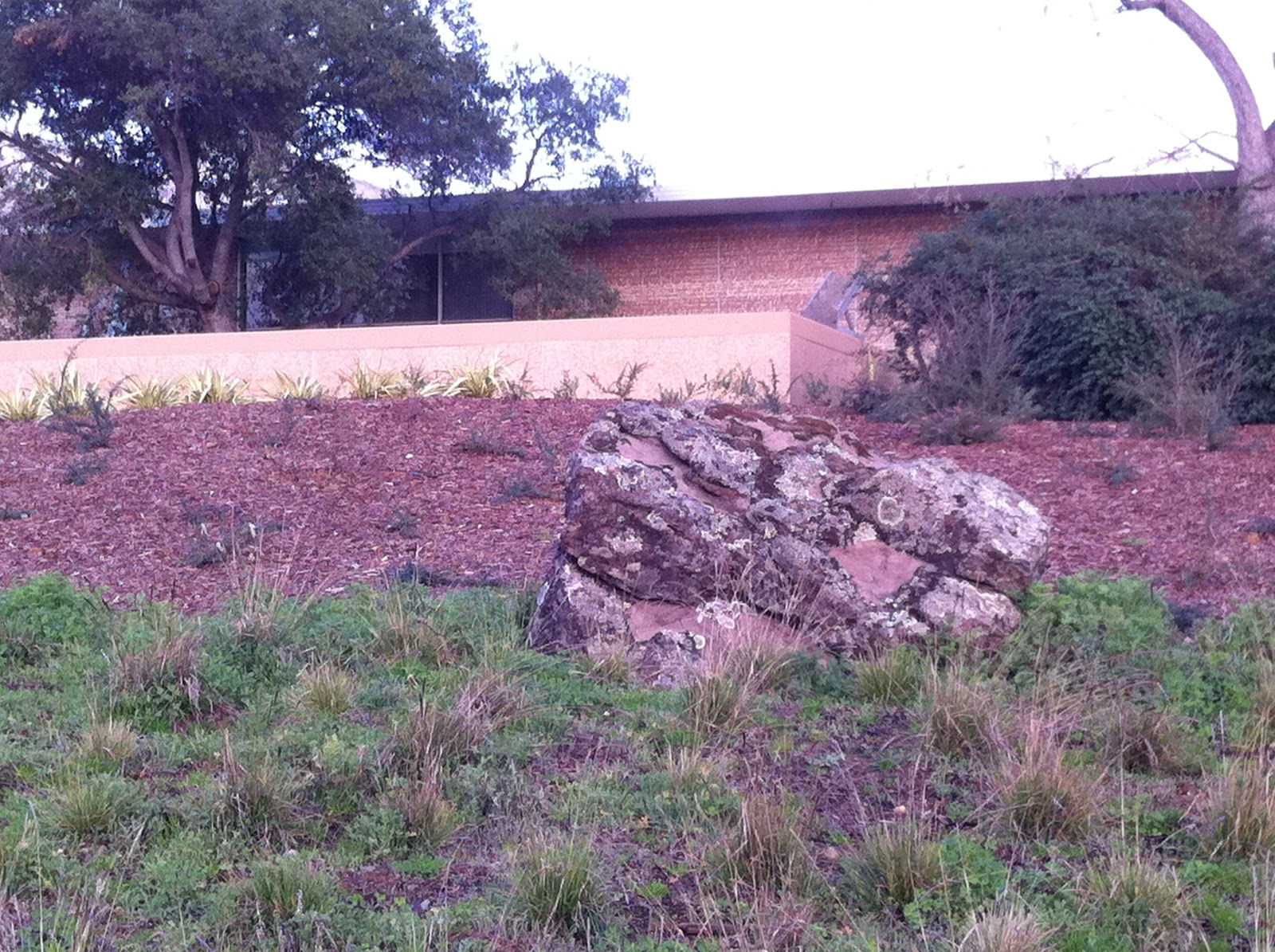
Rock out. Boulders in the landscape are timeless sentinels, a great way to define spaces and make any area feel more natural. They look their best when they seem to be emerging from the earth — I typically specify they be buried to about 1/3 of their height. And bigger is better, perhaps because it seems impossible that such mass could have been placed by man. I was thrilled to see these ginormous specimens going in at the Hewlett-Packard campus at 1501 Page Mill Road in Palo Alto. Too bad some of them didn't go in quite far enough. The groundcover plantings may yet grow up to hide the "taper" at the rocks' bases, so no awards here — yet. But I'm watching.


It's not all bad out there, though. A couple of winners deserve mention:


Acer freemanii 'Autumn Blaze'

Leucadendron species

Muhlenbergia filipes

Go into the light. Especially in the winter when the sun is low and weak, we have lots of opportunities to create stunning effects with plants that either reflect the light or refract it. Palo Alto has been putting in lots of Freeman maples lately, and their color is some of the most brilliant I've seen. Up in San Francisco, this set of Leucadendron from Flora Grubb Gardens positively glows in the late afternoons, as do the massings of Pennisetum and Muhlenbergia grasses at Solage resort in Calistoga. Awards all around for designing with a "light" touch.


How to get air and water to these roots?

Cut a pervious strip into the asphalt

Better still, cut in a lot!

Put down roots. It's not new this year, but I think I'll give my best in show award to the repaved parking lot at Town and Country Village, which has held up extremely well for a few years now. The best part? The permeable "slots" cut into the asphalt, set with interlocking pavers whose gravel-filled gaps allow air and water to reach the roots of the heritage Valley Oak trees that give the property so much character. It's an incredibly simple, yet creative, solution that I haven't seen anywhere else. I'll be "root"ing for its success.


When your eyes are open, it's remarkable how much you can learn from the big guys. Please let me know if you have any lessons to share. And thanks for giving me some of your time this year… here's to continuing our education in 2011!

Dec 20, 2010

A Tree Falls At Facebook

Just up the street from me lives the global headquarters of a little Internet startup named Facebook. The company moved into the former Hewlett-Packard digs at 1601 California last year, making some interesting architectural updates but not really touching the landscape. One of the defining features of the 8.5-acre site was a large Valley Oak (Quercus lobata), which unfortunately was surrounded by lawn for decades. It may look nice and clean, but oaks — even the riparian Valley Oak — and lawns simply aren't compatible. The lawn requires far too much water for the oak's liking, and all that shallow irrigation encourages fungus that stresses, weakens and eventually kills the oak.

Well, Sunday a gust of wind brought the inevitable, and around 10:00 a.m. the tree blew over.

Rotten to the core.
The arborists were still hard at work removing the body some six hours later, and I came by just in time to get a good look at the trunk. I was struck by the amount of rot in the heartwood.

That grayish block just right of center? Concrete.
I haven't counted the rings yet, but the arborists and I guessed the tree was at least 80 years old. It's an ignominious end for such a stately specimen; but are we really surprised? Urban trees are subject to all sorts of ecological insults, from incompatible irrigation to soil compaction, pollution, and sheer human ignorance — the arborist pointed out where concrete had been used to fill a void in the trunk, probably 30 years ago (by the way, please never do this).

There were no outward signs of trouble, and I'm really glad that the huge tree came down on a Sunday morning when the site was largely empty of people. But it is a cautionary tale: if you have a special tree on your property, care for it. Also, cherish it. I don't know how much the Facebook folks appreciated this tree, but it would have been the perfect social hub if the social network had simply pulled out that lawn, put in a more compatible landscape, and added a few benches and tables.

And finally, if you've got a specimen like this in your neighborhood, document it: I was surprised by how few photos I could find of this tree. (The first one above is from Google's "street view.") It's a reminder that nothing lasts forever, and some day we'll want to remember the tree that was.

Nov 15, 2010

Learning from the Big Guys, Pt. 5


Warms the soul, sparks the imagination.
Visiting places that have spent a great deal of money on their grounds is a perfect opportunity to see up close the best and the worst of landscape planning, and to continue learning from the big guys

At one very chic, eco-conscious and rustically contemporary (is that a style? it is now) Napa Valley resort lives this charming concrete fire pit. This hearth is the heart of the outdoor "foyer" at the spa area; it is in the middle of a pathway, with no seating around it, so I'm guessing its purpose is not so much for literally warming oneself as for symbolizing the inner warmth the spa services nurture and awaken. I have a minor quibble with this — lowercase 'q' — because frankly, I enjoy sitting around a fire, and can't do that here without perching somewhat awkwardly on the narrow edge of the wall. (A typical depth for a seatwall would be about eighteen inches, to fit most posteriors comfortably; this is about six inches deep.) On the other hand, this might be intentional, to subtly discourage über-relaxed and probably slightly tipsy guests from sitting too close to an open flame. 

What catches me more are a couple of aesthetic issues. I will grant up front that these may have been conscious choices; however, even if they were, I don't agree with them. First, in this clean and contemporary resort there are lots of straight lines, which the fire pit's square shape complements perfectly. The circular fire burner, however, has no precedent that I can see. Granted, the resort's logo is circular, but this is not carried into the architecture or landscape. What's more, the circle-within-a-square feels busy and disruptive, not calming, to me. A square burner would have been better, and more in keeping with the overall geometry of the place. Funny how such a little detail can have such a big effect.

Section view of a likely form
for the concrete fire pit.
Second, I noticed the horizontal seam about six inches above the pavement, about twelve inches below the top of the wall. This pit is solid concrete, which would have been poured into a "form" comprised of an inner wall and outer wall. Most likely, each wall was constructed of one 2x12 board stacked on top of another to achieve a height of about eighteen inches above the concrete pavement (as shown in my little sketch). The seam probably resulted where the concrete oozed between the boards, as very heavy sludge is wont to do.

Now, forming concrete is a talent I certainly do not possess. But the location of this seam annoys me. Could it have been a conscious design decision? There are other raised planters on the property with the same seam, but other than that I don't see any other precedent for dividing surfaces into 2/3 - 1/3 sections like this. And even if there were precedents, what does it mean? If it were an artistic statement, it should at least be intelligible. So I'm going to guess no, this wasn't an aesthetic choice. I'll guess it was a result of (a) going with the easiest solution to build; or (b) miscommunication between the landscape designer, who didn't specify how the forms should be built, and the builder, who didn't realize the aesthetic consequences of their methods.

One way to center the seam
If I were the designer, I like to think, I would have realized a seam would be inevitable (because there would need to be at least two rows of boards), and would have specified that the seam be centered on the wall. Yes, this probably would have meant using three rows of boards: a 2x12 top board ripped to be 9" tall (so the seam would be halfway down the 18" face), a 2x12 in the middle, and a 2x3 or 2x6 on the bottom.

This level of detail makes the construction much more complex in the short term. So does custom-fabricating a square burner. But in the long term — and we designers are paid for long-term, big-picture thinking — I think it would be worth it if no guest (not even a nit-picky designer) ever looked at this otherwise wonderful resort's fire pit or planters and thought, "Huh. That's weird."