For rain, and sun
For daffodil tips poking through the clay
For fluorescent autumn foliage
For an abundance of work I enjoy
For a warm, dry place to sleep
For two young roosters
For a patient and lovely partner
For the mutual enrichment of friends
For the capacity to create
For another night
For another day
For my clients, my friends, my colleagues, my readers, my family… Thank you.
Nov 27, 2008


Nov 6, 2008
After the Rains
The recent rains were exactly what the Bay Area needed, and not a moment too soon. The billabong started to fill, but drained out just as quickly since the soil isn't anywhere near saturated. Amazing how a long drink springs the landscape to life: my sullen Arctostaphylos suddenly greened up again, and today I noticed the first Narcissus tips poking out of the soil. (Of course, the weeds and winged termites germinated too.) My timing in planting spinach and lettuces just days before the rains was impeccable, and the well-watered sprouts are now basking in the autumn sun. The local Lepidopterae wasted no time in depositing eggs on the broccoli transplants, so we're checking daily for little green worms. As the nights get colder and longer, our tomatoes will slow and finally stop ripening, so I'd guess we're about two weeks from ripping those out before they look nasty... a few extra fruits isn't worth the unsightly tangle of necrotic vines. Other "to do" items before the rainy season really sets in: clean out the rain gutters; install rain barrels; check drains for blocks or leaks; reduce irrigation schedules; clean, oil and shelter garden tools; stack and cover firewood. Those colorful, seductive seed catalogs are about to start arriving in droves; just remember, it's fine to make a wish list, but don't order a thing until you know where it will go in the garden! (Check with me next spring to see whether I've taken my own advice.) I'm sure there's more, much more, to be done... what's your favorite fall-to-winter garden routine?
Oct 27, 2008
Getting the Picture
One of the most important aspects of my work isn't a knowledge of plants, or construction techniques, or materials costs: it's communication. After all, if my clientele or my contractors can't understand what I have in mind, then my horticultural prowess doesn't matter much.
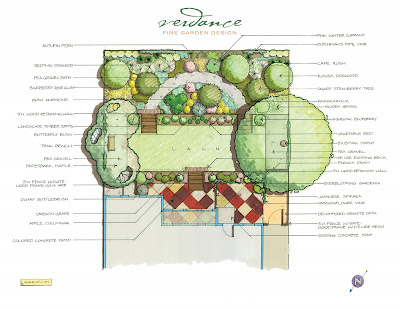 A hand-drafted design conceptTo translate my vision, I rely on clear, detailed design plans. There are any number of ways to create plans, from quick sketches to detailed hand-drafting to the precision of computer-aided design (CAD), and every designer has their favorite set of planning tools.
For better or worse, recent years have seen a burgeoning of "do-it-yourself" garden design software; it's aimed at homeowners, but some landscape designers and contractors use these programs as well to streamline their processes. On the other end of the spectrum are high-powered CAD programs such as AutoCAD and VectorWorks, which can lay out a semiconductor chip or a 200-story office tower as handily as a flagstone patio. And somewhere in between are apps like Google SketchUp, powerful enough for pros to rely on but easy enough for almost anyone to learn and use at some level.
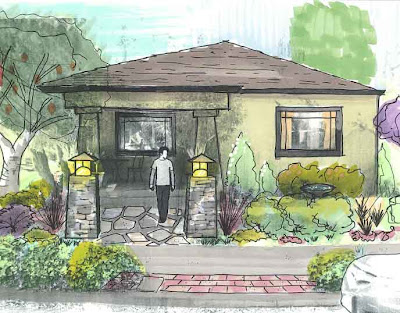 SketchUp and hand-sketching over a photo
In my studio, I find the clearest way to communicate my ideas is with a suite of SketchUp, VectorWorks and hand-drafting. I do love me some tech: VectorWorks lets me precisely plot site dimensions, features and structures, and quickly calculate areas and quantities, while SketchUp helps me reality-check my ideas, often helping me recognize their impracticality (or impossibility) before I get too wedded to them.
But there's a dark side to all this power and convenience: we can easily become dependent on it, and begin to design within its limitations. In other words, we might have a great idea — but if we don't know how to execute it with AutoCAD, that idea never makes it to the design. Or if we persist, and invest the time to learn how to execute that idea with AutoCAD, we have less time to explore other, possibly better ideas. Drafting by hand gives me the speed and flexibility to churn out a dozen very different concepts in a day if necessary; even in a program as friendly as SketchUp, such dexterity is virtually impossible.
The ASLA has recently published a piece on what technology can do for landscape architects. It's an interesting read from an insider's point of view. And, it doesn't miss the bigger picture: that there are some things technology just can't do.
 A hand-drafted design conceptTo translate my vision, I rely on clear, detailed design plans. There are any number of ways to create plans, from quick sketches to detailed hand-drafting to the precision of computer-aided design (CAD), and every designer has their favorite set of planning tools.
 For better or worse, recent years have seen a burgeoning of "do-it-yourself" garden design software; it's aimed at homeowners, but some landscape designers and contractors use these programs as well to streamline their processes. On the other end of the spectrum are high-powered CAD programs such as AutoCAD and VectorWorks, which can lay out a semiconductor chip or a 200-story office tower as handily as a flagstone patio. And somewhere in between are apps like Google SketchUp, powerful enough for pros to rely on but easy enough for almost anyone to learn and use at some level.
 SketchUp and hand-sketching over a photo
In my studio, I find the clearest way to communicate my ideas is with a suite of SketchUp, VectorWorks and hand-drafting. I do love me some tech: VectorWorks lets me precisely plot site dimensions, features and structures, and quickly calculate areas and quantities, while SketchUp helps me reality-check my ideas, often helping me recognize their impracticality (or impossibility) before I get too wedded to them.
But there's a dark side to all this power and convenience: we can easily become dependent on it, and begin to design within its limitations. In other words, we might have a great idea — but if we don't know how to execute it with AutoCAD, that idea never makes it to the design. Or if we persist, and invest the time to learn how to execute that idea with AutoCAD, we have less time to explore other, possibly better ideas. Drafting by hand gives me the speed and flexibility to churn out a dozen very different concepts in a day if necessary; even in a program as friendly as SketchUp, such dexterity is virtually impossible.
The ASLA has recently published a piece on what technology can do for landscape architects. It's an interesting read from an insider's point of view. And, it doesn't miss the bigger picture: that there are some things technology just can't do.
Oct 19, 2008
Save the Planet (?)
 Dining this afternoon at the Hard Rock Cafe, whose "Save The Planet" slogan is everywhere... Especially all over their kids' activity book (5 pages of 30% recycled paper), plastic cups, and cellophane-packaged aspen tree seeds with paper insert. How many people will actually plant those? Will aspen trees even grow in your climate zone? (They will survive, but certainly not thrive, in mine.) Would another species be more appropriate? Is the whole gimmick crap, a net environmental loss rather than gain?
Oct 14, 2008
Don't Do This To Your Tree

Working with a professional garden designer, who knows how big a tree will get (and how much clearance to give furnishings like tables, chairs and heaters), can help you avoid problems like this before your plans ever get off the ground.
Subscribe to:
Posts (Atom)