May 4, 2010

Learning from the Big Guys, Pt. 4

(By the way, I had nothing whatsoever to do with this combination of 'St. Josephs Coat' rose, unspecified iris, and Cerastium tomentosum… I saw it last week in a Los Altos front yard, and it just makes me happy.)

I've written before about learning from the big guys, but sometimes we can learn from the little guys, too — particularly when they make mistakes that, although not big in an absolute sense, are relatively huge.

I met recently with a Palo Alto homebuilder of considerable repute, who had endured what he deemed a "terrible" experience with a garden designer who also is a licensed landscape contractor. Hoping to learn from her missteps, I pressed him on what had gone so wrong. It boiled down to essentially three sins:

One, she didn't take direction. "We would make changes to the plan," the builder said, "and the same things would show up in the next revision." To me, it sounded like a rookie mistake: confusing your own interests with the client's. I'm not saying the client's ideas are always right; but their interests are.

Two, the designer's ideas were weak. Perhaps she threw them together hastily, perhaps she went with her first thought instead of developing more concepts and challenging her own limits. Perhaps she wasn't paid enough to put adequate time toward concept development. I don't know. I wasn't there. But none of those is a good excuse for faulty logic or cookie-cutter designs.

Third, she overstepped her role. Assigned to develop a pathway, she reconfigured the front porch as well. (This upset the architect considerably.) Given a budget and scope of work by the builder, she "added value" with elements that were integral to the design yet unaffordable. As a contractor herself, the builder said, she should have been able to provide creative alternatives without losing sight of costs.

In fairness, I got only one side of the story. But it's a great cautionary tale regardless. Landscape designers are not fine artists, accountable only to ourselves; we are commercial artists, accountable to our clients (and often serving many clients with a single work). Our creativity is meaningless if we lose sight of its object. And while we're certainly entitled — obliged, even — to stand up for our ideas, we mustn't forget that we do not have to live with our own work.

Having a good idea isn't enough: we must have the right good idea.

Mar 30, 2010

Winter Into Spring

Interesting phenomenon: as soon as we got a few sunny days this month, my phone started ringing off the hook with people who "want new landscaping in time for summer." This actually is typical of this season, as it gradually dawns on us that winter may actually end some day, and we may get to spend some time outside again.

No one wants to defer gratification, or make yet another summer's worth of excuses for the state of their yard. But the rains look like they might be around a while longer, and that saturated muck we call soil is no fun for even the most ardent DIY-er to work with. What's more, by this time of year, the good contractors are booked solid for the spring and into summer.

So what's an impatient homeowner to do?

1. Throw money at it. There's no problem that can't be solved when you multiply your budget 4x. Hey, the markets have been on a roll lately, right?

2. Call a dozen contractors for bids. After all, there's gotta be one that's not booked up. (But, to save time, make sure you don't call any of their most recent customers for references.)

3. Lower your design standards. So what if you really wanted a stone patio and redwood arbor? You'll get used to the gravel in time, and you can probably get a really good deal on a charming patio umbrella on craigslist.

4. Do it yer damn self. Because you're really good at things like this.

5. Start planning now for autumn. Contact a really good garden designer now and commission a unique landscape design, to be installed in the fall. Your preliminary concepts should be done by June. You can start contacting contractors in July. Get final plans and bids by August. And break ground in September. Your plants (installed in October or November) will appreciate all the winter rains, as will your irrigation budget. Your wallet won't get raked over the coals by the laws of supply and demand. And in exchange for your patience and wisdom, you'll have an excellent new landscape, at an excellent price, less than a year from now.

It's not quite instant gratification. But it's probably a result you can live with.

Feb 8, 2010

Fast, Good and Cheap

In a previous life I worked at one of the best ad agencies in the Bay Area. It wasn't quite Mad Men, but we did have our Friday open bar, our eccentric namesake, and our brilliant but misunderstood creatives — who gave me some pearls of wisdom that resonate to this day.Perhaps the most impactful was a simple graphic on an art director's door: a triangle with the words "fast," "good" and "cheap" at its points, anchored by the admonition "Pick Two."

I've come across this concept a few times since, so I don't think it was Kathy's invention. But at the time, it hit me like a lightning bolt: Anything is possible, and everything has a price.

Landscape designers, architects and contractors confront this triangle a lot. Especially this time of year, when folks remember they wanted a new back yard for the kids to play in this summer. They call me, full of optimism and good ideas… and their disappointment is audible when they realize I can't start on their landscape design immediately, or that the consultations I can offer in the next few weeks (to get them off to a roaring start with a landscape contractor now) actually cost money.

Is the problem that we live in an age of instant gratification and commoditized services? The internet has made seemingly all things available to all people, and often for free: want a book tomorrow, without the inconvenience of driving to your local bookstore? Amazon does that. Want to try on shoes, without having to drive to the store or pay to receive or return them? Zappos has you covered.

But landscape designers and contractors aren't retailers. Our work isn't a commodity that can be comparison-shopped. Sure, the local gardener can advertise design services just as legitimately as I can (though there might be vast differences in our training), and probably get to your project a lot sooner. He probably costs a lot less, too. But would he and I give you the same artfulness in our designs, the same thorough process, the same attention to detail from beginning to end? "Fast and cheap" still carries a cost.

My neighbor, who is incredibly nice, smart, and well-intentioned, took it upon himself around Hallowe'en to rebuild his front irrigation system. I remember the skeleton bones he poked out of the trenches; great effect. But now, some three months later, he's just finishing the project (although still sans plants). Is his labor cheap? Definitely. Good? Probably. Fast? Not so much.

Fast & Cheap
(the graphics, not the ideas)
At different times, I'm different legs of the triangle. My clients will tell you I'm pretty good. And depending on the circumstances, I can be relatively cheap, or pretty fast (as those Landscape Smart episodes attest). I'm not immune to mistakes, especially when I try to cram too much work into too little time; that's when "good" gives way to "fast." The only way to reclaim "good" is to put in more hours, usually in the middle of the night, and there goes "cheap."

I've worked with all types of clients. Some are willing to sacrifice "good" in the name of "fast and cheap." They're the ones hiring unlicensed contractors who don't bond their projects or pay worker's comp insurance. These aren't my ideal clientele, because there's no assurance the project will turn out well, and no real recourse if it doesn't. My favorite clientele are the ones who choose "good", and realize that choice includes a tug-of-war between "cheap" and "fast."

I've built my business, and my reputation, on providing "good" (well, actually, "great"). So that leaves either "cheap" or "fast." I'm happy to be either. I just can't be both.

Jan 18, 2010

It's Raining! Now What?

It's been hard to miss the message over the past year that we're in a drought. And Californians have responded remarkably well: residential water use was reduced by 9.4% in Santa Clara County, 12% in Los Angeles County, and up to 25% in San Diego County from previous periods. I still see far too many gratuitous lawns, thirsty "exotic" plants and wasteful irrigation systems. But on the whole, we're at least trying to handle our water.

So the next place to look is, naturally, increasing our supply. And on the cusp of a major El NiƱo week like the one currently forecast for the Bay Area, the opportunities seem abundant. So why isn't everyone harvesting rainwater? To understand why it's not quite that simple, let's do a little math:

    First, let's assume we're in for nine inches of rain — that's 3/4 foot — over the next week or so.

    Second, let's assume we can harvest that rain from the roof of our detached 2-car garage, which has a roof area (equals footprint) of about 20 feet by 20 feet.

    So if we catch every drop that falls on our roof, we would harvest 20' * 20' * 3/4' = 300 cubic feet.

    Using a handy-dandy volume converter, we find that 300 cubic feet equals 2,244.156 gallons.

Holy crap! Seriously?! More than two thousand gallons? That can't be right.

    Well, actually, it isn't right. Because we won't catch every drop. Some will splash away, some will get trapped in the gutters, some will leak out. So a capture rate of 60% is usually considered reasonable, and our potential volume actually is 2,244.156 * 60% = 1,346.494 gallons.

Holy crap! Seriously?! More than thirteen hundred gallons?

Yep. And unfortunately, that huge number is less than 5% of the annual water needs of a 1,000 square foot lawn. Never mind that if you're serious about water conservation, you don't have a 1,000 square foot lawn; are you getting a sense of the quantity of water we're talking about? Say you did have a 20'x50' patch of grass: 1,346 gallons of rainwater would irrigate it for all of about two weeks. For the year you'd need twenty times that, or around 27,000 gallons.

Which raises another issue, specific to Mediterranean climates like ours where most of the rain comes in one season, as opposed to throughout the year: storage.

We get most of our rain during the winter, when plants are dormant and evapotranspiration rates are low. We don't need the captured rainwater now. We need it six to nine months from now, when skies are sunny and the ground is parched. Even if you have no lawn and your xeric garden only needs 1,300 gallons, where do you store what you've saved?

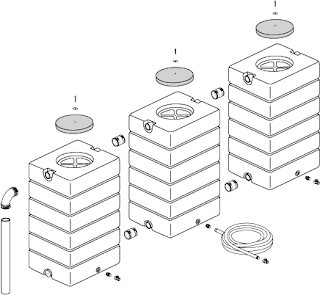
Rain BarrelRainwater PillowRain BoxRainwater HogThere are in-ground cisterns, which may be large enough but are pricey and complicated to install. There are classic, above-ground rain barrels, which are bulky and difficult to link together for additional capacity. There are interesting systems like the Rainwater Pillow which can efficiently store 1,000 gallons or more, but may not be ideal for exposed outdoor locations. And there are modern above-ground tanks such as the Rain Box and Rainwater Hog, which link together with slim rectilinear profiles that use space efficiently but can become pricey.

How pricey? The Rainwater Hog sells in the neighborhood of $500 per 50-gallon tank. To catch 1,346 gallons requires 27 tanks, or $13,500. The Rain Box is more economical, at about $250 per 75-gallon box. But that's still 18 boxes, or $4,500.

Even if cost isn't a consideration, space may be. The Rainwater Hog has such a slim profile — just 20" wide by 10" deep — that it can be mounted not only vertically against walls, but also horizontally, e.g. beneath a deck. But no matter how you set them up, 27 tanks would take a lot of room: far more than the 20' wide wall of our two-car garage. The Rain Box is bigger, about 24" wide by 20" deep, and not designed to mount horizontally; so 18 boxes would need at least 36', or almost two full walls of the garage.

I don't mean to discourage anyone from catching and reusing every drop possible. Even if your "rain barrel" is a garbage can, that's 20 or 30 gallons you don't need to draw from a reservoir. But it won't be your only solution, and in fact might raise more questions, e.g. what do you do with the overflow? We all can install green roofs, detention basins and porous paving, which will help the rain get into the groundwater where it actually can do some good. But these solutions aren't the same as storage; and they're not cheap, either.

I guess my point is that it ain't easy to save the world. It's probably not economical, and you probably won't get your money back. Serious rainwater harvesting requires some serious commitment, and we're not all there just yet. But even if you're not ready to shell out thousands of dollars to store thousands of gallons, you have plenty of other options. Maybe you can swap out your lawn for a delightful garden of unthirsty plants. Maybe you can mulch those plants with 3" of compost instead of leaving the soil bare. Maybe you can redo your driveway with pervious pavers instead of asphalt. Maybe you can take shorter showers or make other changes that reduce your water footprint.

Maybe you can't do much; but you can do something. And what better time to start than now — while there's a break in the weather?

Dec 22, 2009

The Great American Desert

[I wrote this piece a few years ago, but the History Channel's recent broadcast of Black Blizzard, along with Tim Egan's narrative and interviews with Dust Bowl survivors, makes it worth repeating.]


"When the native sod of the Great Plains was in place, it did not matter if people looked twice at a piece of ground. Wind blew twenty, thirty, forty miles an hour, as always. Droughts came and went. Prairie fires, many of them started deliberately by Indians or cowboys trying to scare nesters off, took a great gulp of grass in a few days. Hailstorms pounded the land. Blue northers froze it so hard it was like broken glass to walk on. Through all of the seasonal tempests, man was inconsequential. As long as the weave of grass was stitched to the land, the prairie would flourish in dry years and wet. The grass could look brown and dead, but beneath the surface, the roots held the soil in place; it was alive and dormant.
The short grass, buffalo and blue grama, had evolved as the perfect fit for the sandy loam of the arid zone. It could hold moisture a foot or more below ground level even during summer droughts, when hot winds robbed the surface of all water-bearing life. In turn, the grass nurtured pin-tailed grouse, prairie chickens, cranes, jackrabbits, snakes, and other creatures that got their water from foraging on the native turf. Through the driest years, the web of life held. When a farmer tore out the sod and then walked away, leaving the land naked, however, that barren patch posed a threat to neighbors. It could not revert to grass, because the roots were gone. It was empty, dead, and transient."


—Timothy Egan, The Worst Hard Time: The Untold Story of Those Who Survived the Great American Dust Bowl

Read this book.