Sep 21, 2005

Taking The Fall

[Note: Verdance clients originally received this article at the beginning of this month, as part of our free monthly newsletter on gardens and gardening. To subscribe to the newsletter yourself, please register at verdancedesign.com.]


Have you noticed yet? Nights are cooling off, leaves are showing red, and — my favorite — the sunlight is softer and more golden. Autumn is here! The equinox occurs on Sept. 22, and then nights will outlast days until March.

I'm often asked, is fall the best time to plant in the Bay Area or not? While I wouldn't delay a project by 6 or 9 months just for the season's sake, it definitely beats summer: plants are less stressed, need less water, and have more time to develop healthy roots before next year's heat.

Another good reason to plant over the next few months is that nurseries have terrific inventory now. Sure, there are some sun-baked has-beens on the racks, the runts that never quite endeared themselves to other gardeners, but lots more are in fine shape, a little mildewy or root-bound at worst. (And frankly, I even view the runts as opportunities, tests of my horticultural mettle.)

Of course, if you're looking to add a little fall color to your landscape, now's also the time to shop. Look for Chinese pistache, crape myrtle, sour gum, oakleaf hydrangea, Boston ivy and Virginia creeper, Japanese and other maples, and ornamental grapes, cherries and pears. And don't forget about plants with interesting berries or seeds: grass plumes positively glow when backlit by the rich autumn sun. (If you would like ideas on what or where to plant for best effect in your garden, just let me know.)

Since those fiery reds, oranges and yellows actually only appear in the absence of green clorophyll — and since clorophyll production typically stops as plants retreat into winter dormancy — you can encourage autumn colors by sending signals now that summer is over. Stop watering established plants (short of wilting them) to discourage new growth; and locate new trees, shrubs or vines in full sun for the most extreme temperature changes as nights get colder.

One class of plants that clearly benefits from fall planting, although they're not much for fall color, is California natives. These take advantage of the winter rains to develop robust root systems that can endure our long dry summers. I'll say more about natives in future posts, but for now check the California Native Plant Society for lists of botanic gardens, nurseries, and plant sales — yet another reason to love autumn in the Bay Area.

Sep 9, 2005

Planning to go native?

This is a really good month to start replanning your garden, especially if you're at all interested in California native plants, because of all the great nursery sales now. Despite a reputation for being less than showy, native (or adapted) plants can indeed give you a great-looking garden... as well as the pride of knowing that you're helping the environment in many ways.

One of my favorite plantspeople, Peigi Duvall, will be speaking on "Going Native, Going Sustainable" on Sept. 23. Peigi is a landscape designer and Director of the Horticulture Program at the California Native Plant Society. Hers will be the featured talk at the CNPS general meeting, which is free and open to the public:
Friday, September 23, 7:30pm.
Saratoga Library Community Room
13650 Saratoga Avenue, Saratoga.
For more information, contact CNPS Chapter Vice President Kevin Bryant at mtngreen17@verizon.net or (408) 353-8824.

Aug 29, 2005

Cooling Down Hot Bougainvillea

Saw a nice combination the other day: if you've got a hot purple Bougainvillea
that attracts a little too much attention, an effective way to cool it down is with the fast-growing Ipomoea tricolor (blue morning glory) vine.

The Ipomoea is a tender perennial best treated as an annual, but it blooms at just the right time to complement the Bougainvillea's colorful bracts. Plant one or two Ipomoea seeds near the base of the Bougainvillea -- they'll clamber on up through the larger, stronger vine, cooling down that bright purple while keeping the tropical effect intact.

Ipomoea seeds germinate best when soaked in warm water for 12 hours, or scarified with an emery board or sandpaper, prior to planting in early spring. Like Bougainvillea, Ipomoea resents having its roots disturbed, so it's best to sow the seeds in place (or, if you start with a container-grown plant from a nursery, handle carefully during transplanting).

Aug 23, 2005

Addicted to Lawn

[Note: Verdance clients originally received this article in June, as part of our free monthly newsletter on gardens and gardening. To subscribe to the newsletter yourself, please register at verdancedesign.com.]

Per square foot, no other planting consumes water, fertilizer, chemicals, energy, money and time like a lawn. Normally we would go out of our way to avoid such a demanding specimen; but since we continue to spend and suffer for that patch of green, we might as well face it: we're addicted to lawn.

Does manicured grass satisfy some human urge to control nature? Or is the attraction in our cells, a relic of the days we called the African savanna home? Whatever the origins, today the relationship is largely symbolic: we love lawn because we have always loved it -- its calming uniformity, its cool tickle, its fresh-cut aroma, its evocations of youth and play and carefree days.

As a landscape designer, I can't ignore that even a small lawn can carry big costs to our wallets, our environment and our quality of life. Yet turf does make an excellent play surface, and its bold monochrome is a good foil for more intricate shapes or textures. It even has ecological benefits, generating oxygen, cooling the air, absorbing pollutants and preventing erosion.

We probably will never kick the lawn habit entirely. But we can reduce our dependency by using lawn only where nothing but turf will do (usually a play area), and using as little as will suffice (under 100 square feet for a putting green, around 400 sf. to throw or kick a ball, 8820 sf. for a proper game of croquet).

Beyond that, lawn is mostly aesthetic, and legions of more satisfying alternatives exist. A carpet of chamomile or thyme, for instance, is extremely sensuous. A massing of low ornamental grasses provides bold uniformity. And a charming perennial bed can attract so many birds and butterflies that we forget all about the lawn it replaced.

I could go on an on about ingenious lawn substitutes and efficient care practices. And if you want to know more about these, I'm happy to help. But right now -- if you'll excuse me -- I have to go mow my lawn.

Aug 7, 2005

Sweating Bullets

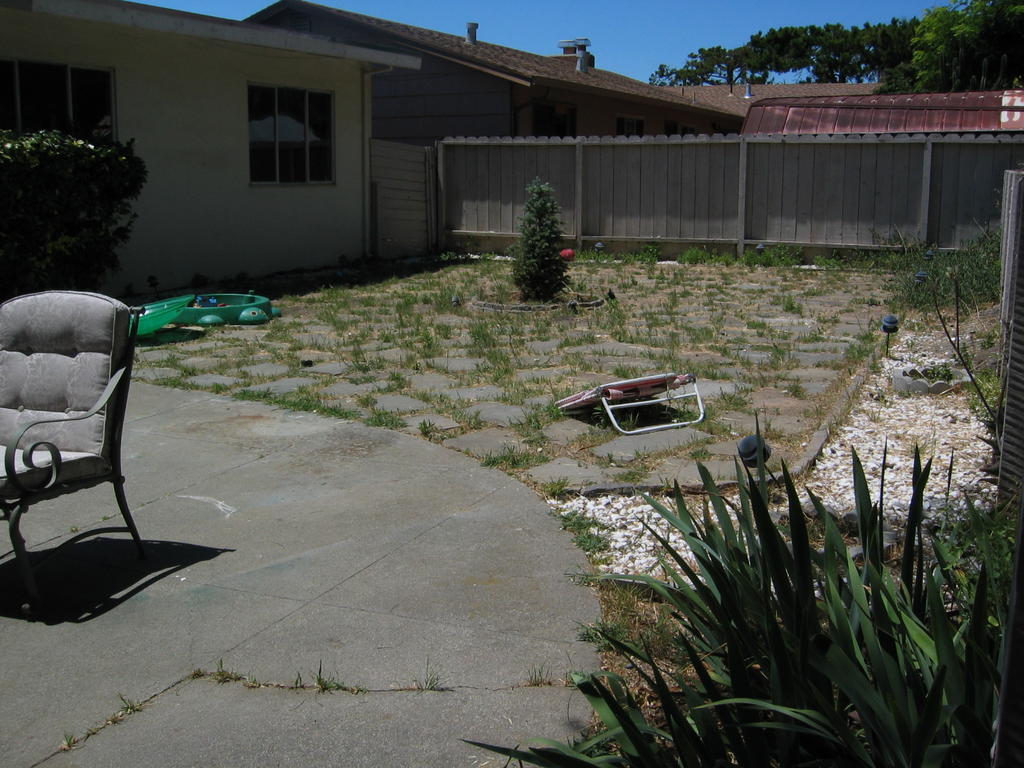
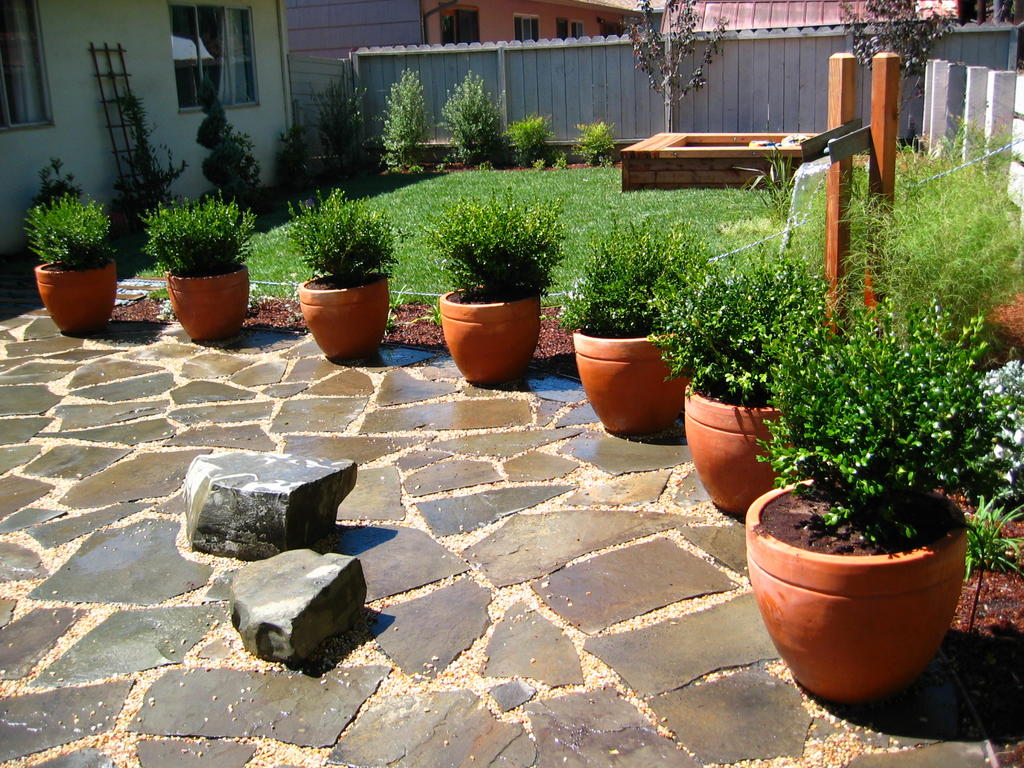
Well, somehow we did it! And the transformation is nothing short of stunning. Here's the residence
before we got our hands on it...

...and
after.

Frankly, I'm a bit astonished it came together so well, especially in just two days. Never underestimate the quality of your crew...

...or your design!